
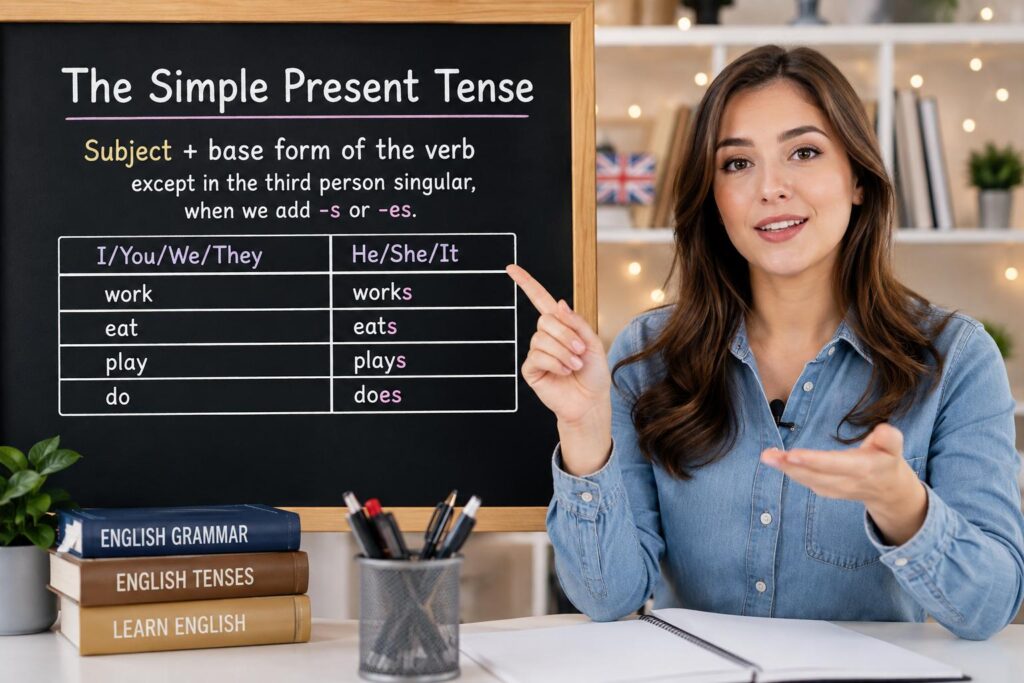
The Simple Present Tense, also known as the Present Indefinite Tense, is one of the most common and important tenses in English. We use it to talk about habits, routines, repeated actions, general facts, universal truths, timetables, instructions, to relate stories, and many other situations.
Although its structure is relatively simple, understanding its different uses can sometimes be challenging. In this guide, you will learn when to use the Simple Present Tense, how to form affirmative, negative, and interrogative sentences, and the rules for using “s” and “es” with verbs.
With clear explanations and practical examples, you will be able to use the Simple Present Tense more confidently in both speaking and writing.
USAGES
1. The simple present tense is used to express a repeated action that indicates the past, present, and future. Repeated actions are permanent situations or things that happen regularly or all the time, but it doesn’t mean right now.
Example:
How does Mike earn a living?
He teaches English at the school.
The verb “teaches” is in the simple present tense. It indicates Mike’s activities in the past, present, and future. Here, “teaching English” is a repeated action. He taught English in the past, is teaching English now, and will teach English in the future. So, a repeated action is an action that we do daily. We begin such actions in the past, continue them in the present, and will continue them in the future. We don’t know how long these actions will continue in the future.
2. The simple present tense indicates habitual actions. Although it resembles a repeated action, habitual and repeated actions are different; both must occur.
Example:
She smokes.
It does not mean that the action is taking place right now. It doesn’t happen at the moment, but it shows a habit, and we know that habit comes from the past, is in the present, and often continues in the future.
But a question arises over here: what is the difference between a repeated action and a habitual action? Habitual is also a repeated action. We do both actions daily at a particular time, but a repeated action can easily be avoided. In contrast, a habitual action can’t be avoided easily, despite its harm if it is a negative habit. A child may become happy if his parents stop him from going to school, which is a repeated action.
But if he is stopped from a habit, he may become upset and resist stopping. Habit can also be said to be a personal trait. Its benefit or harm is limited to a person’s self, but repeated action relates to society or to the people around you. You work or interact with them, and so repeated action comes into being. So both actions have to be done, and both are obligations, but the difference is as explained above.
3. The simple present tense is used with the word “say” when we talk about notices / recently received letters, when we quote from books, etc.
Examples:
a. He says (in the letter) he is visiting me next month.
b. “Everything is fair in love and war”, says Shakespeare.
c. A notice at the end of the road warns people not to go further. The road is under construction.
In the above examples, the simple present tense is referring to notices, recently received letters, and quotes with the help of the word “say”.
4. The simple present tense is used in newspaper headlines.
Example:
PM urges the world to undo climate injustice.
The action “urge” occurred in the past. The PM’s debut speech at the UN General Assembly was held in the past, in which he urged the world to undo the climate injustice, but the headline is given in the simple present tense. It may be noted that the action occurred in the recent past.
5. The simple present tense is used to express a universal truth.
Example:
The sun rises in the east.
We all know that this action has been taking place since the inception of this universe. It is the same course of action and will continue until this system ends. The universal truth is the truth that can’t be rejected anywhere in the world.
6. The simple present tense expresses the action in the actual current moment.
Examples:
a. The meat smells bad (at this time).
b. The boss declares the meeting closed.
c. The party leader apologizes for the trouble.
In the above examples, the actions are taking place right at the actual present moment.
Although the Present Continuous is normally used for actions happening now, the Simple Present can be used in certain situations, particularly for announcements and immediate reactions. It is mainly used in demonstrations, descriptions, or explanations. It is used when a cook shows someone how something is cooked or when a teacher is performing an experiment, etc.
Example:
The meat smells bad.
The referee declares the match over.
The manager apologizes for the inconvenience.
How to cook the Roma Sauce?
Pour three tablespoons of oil into a large pan. Slice two onions. Put the onions and some garlic in the oil. Cook the onions and garlic for three minutes. Add two pounds (about one kilo) of ground meat. Cook the meat and onions for ten minutes. Add one small can of tomato paste, one large can of tomatoes, and two cups of water. Season the sauce with salt, pepper, oregano, and basil.
Mmmm! It smells delicious. Now, cook the sauce for one hour. Serve the sauce on spaghetti with grated cheese.
In the above example, we use the simple present tense, though the action is actually in progress and happening in the moment.
7. The simple present tense is used in commentaries. For instance, commentary during a football match or any other sporting event.
Examples:
Mike passes the ball to Bob, and Bob passes it to Gino, who beats the goalkeeper and scores a goal.
The simple present is commonly used in sports commentary and live descriptions of rapidly changing events.
Here are some more examples:
– Here comes the bus!
– There she goes!
– There goes the bell!
8. The simple present tense is used to express planned future actions. It is for timetables and scheduled future events
Example:
The train leaves the station at 3:00 tomorrow.
The class starts at 9:00 tomorrow.
Our flight arrives at 6:30 p.m.
The examination begins next Monday
In the above example, it is very clear that the action is taking place in the future, but the simple present tense is used because it is a planned action.
9. The simple present tense is used when we give directions.
Example:
Walk along Main Street until you reach Station Road. Turn right at the traffic light and continue for two blocks. Then turn left onto University Street. The library is on your right.
10. The simple present tense is used for informal narration and in summaries of stories or plays.
Example:
Othello meets Desdemona’s father in Act 1.
For telling or writing stories or summaries of stories and plays, we usually use the simple present tense. It is also used for telling stories.
11. We sometimes use expressions such as I hear, I see, and I understand when referring to information we have just learned or discovered.
Examples:
I hear he’s moving to the USA.
I see there has been trouble during the meeting.
I understand that the project has been completed.
12. The simple present tense is used for general facts and statements.
Examples:
I am a student.
My name is Lisa.
She is a teacher.
The “verb to be” is an exception in the simple present tense. It has its own forms in the simple present tense. They are “am, is, are”.
STRUCTURE
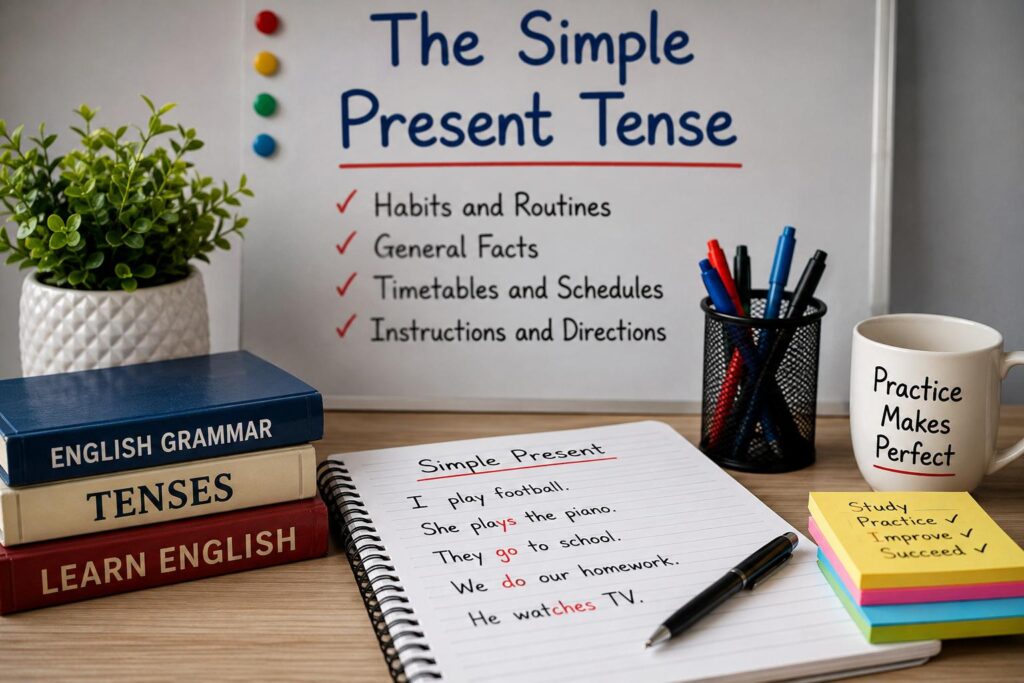
Like its name, the structure is fairly simple.
Positive or Affirmative Sentence
Adela cooks Mexican food.
I play football. They play football.
He plays football.
She watches television.
Formula:
Subject + base verb / verb + s-es + object
Rule:
Use -s or -es with the verb when the subject is he, she, it, or a singular noun.
In the above sentence, the word “Adela” is the subject, “cooks” is the verb, and the word “Mexican food” is the object.
We can see the letter “s” has been added to the base form of the verb “cook” in the above sentence. It is very important to know when to add “s” or “es” to the base form of the verb in the simple present tense. So remember, when the subject of a sentence in the simple present tense is third-person singular, i.e, he, she, it, or a name, then we add “s” or “es” to the base form of the verb.
When to add, “s” or “es”?
– If a verb ends in s, ss, o, x, sh, or ch, we add “es” with the verb in the simple present tense, and the rest of the verbs take only “s” but remember we add it when the subject is third person singular in the simple present tense otherwise we don’t add anything to the verb to make a sentence in the simple present tense.
Negative Sentence
Adela does not cook Mexican food.
Formula:
Subject + do not/does not + base verb + object
Examples:
- I do not like coffee.
- They do not work on Sundays.
- He does not play cricket.
- Adela does not cook Mexican food.
Remember:
Use does with he, she, it, or a singular noun.
After does, always use the base form of the verb.
✅ She does not work.
❌ She does not works.
To make a negative sentence in the simple present tense, we add “do not or does not” just before the verb. The order of other words remains the same as that of a positive sentence.
When to use “do” and when to use “does”?
Again, if the subject of the sentence is third person singular, we use “does” to make a negative sentence in the simple present tense, and if the subject is not third person singular, then we use “do” to make a negative sentence in the simple present tense.
“Do” and “does”| are the same words. In fact, “do” becomes “does” when we take the letter “s” or “es” from the verb and add it to the word “do”, just like in the sentence “Adela cooks Mexican food” becomes “Adela does not cook Mexican food”. In the sentence, we see how we took the letter “s” from the verb “cook” and added it to the word “do”, which became “does”. So when “does” is used, we don’t use “s” or “es” with the verb.
Interrogative Sentence
Does Adela cook Mexican food?
Formula:
Do/Does + subject + base verb + object?
Examples:
- Do you speak English?
- Do they live here?
- Does she work here?
- Does Adela cook Mexican food?
Short Answers
- Do you like tea? Yes, I do. / No, I don’t.
- Does he play football? Yes, he does. / No, he doesn’t.
To make an interrogative sentence, we just put “do” or “does” before the subject. Again, if the subject is third-person singular, put “does” before the subject; otherwise, put “do” before the subject to make the interrogative sentence in the simple present tense.
Negative Interrogative Sentences
There are two common forms.
Contracted form:
Don’t/Doesn’t + subject + base verb + object?
Doesn’t Adela cook Mexican food?
Full form:
Do/Does + subject + not + base verb + object?
Does Adela not cook Mexican food?
The contracted form is much more common in everyday English.
Negative interrogative sentences can be made in two ways. If the word “not” is contracted with the auxiliary verb, then it comes before the subject, and if it is not contracted, then the word “not” comes after the subject to make a negative interrogative sentence. In the first sentence, the word “not” has been contracted with the auxiliary verb, while in the second sentence, it has been used in expanded form, and that’s why it has been put after the subject of the sentence.
The Simple Present Tense of “Be”
The verb be has different forms:
| Subject | Form of Be |
|---|---|
| I | am |
| You | are |
| We | are |
| They | are |
| He | is |
| She | is |
| It | is |
Examples:
- I am a student.
- She is a teacher.
- They are ready.
Negative
- I am not tired.
- He is not at home.
- They are not late.
Questions
- Am I late?
- Is she a teacher?
- Are they ready?
Important: We do not use do or does with the verb be.
❌ Does she be happy?
✅ Is she happy?
Common Mistakes in the Simple Present Tense
1. Adding “s” with I, You, We, and They
❌ They plays football.
✅ They play football.
2. Forgetting “s” with He, She, and It
❌ She work every day.
✅ She works every day.
3. Using “does” with a verb ending in “s”
❌ He does not works here.
✅ He does not work here.
4. Using do/does with “be”
❌ Does she be a teacher?
✅ Is she a teacher?
5. Confusing the Simple Present with the Present Continuous
She works every day. → regular action
She is working now. → action happening at the moment
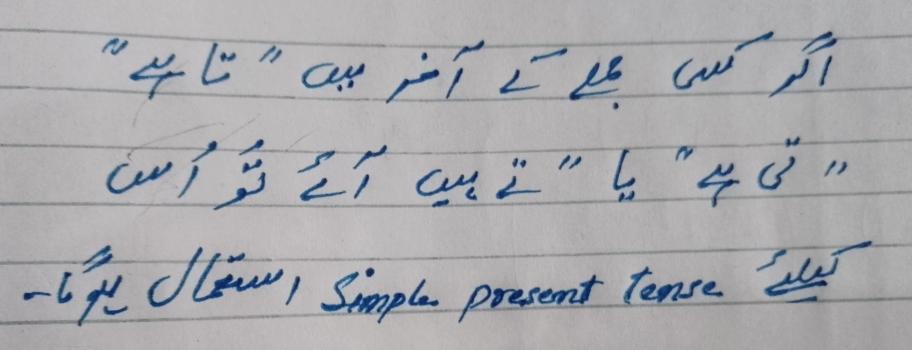
RECOGNITION IN URDU
Examples:
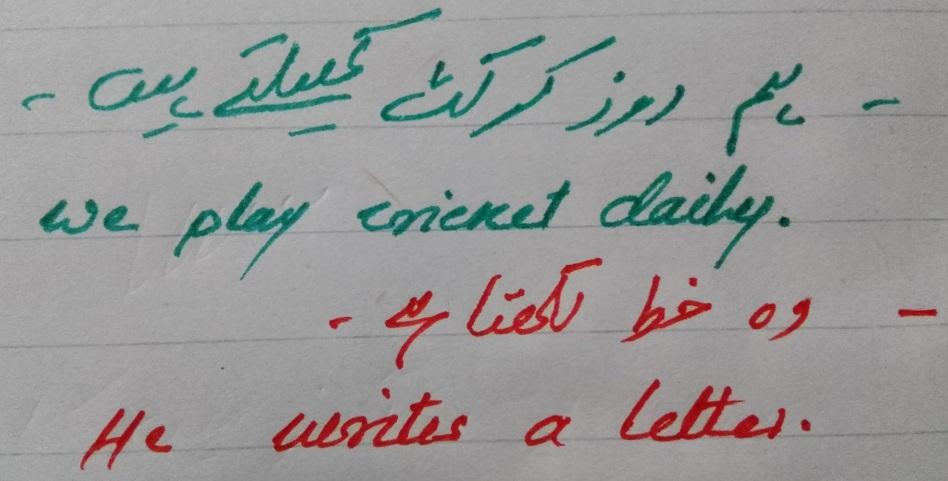
Recognition in Urdu is very important. It helps a lot in translation. If you don’t know the tense of a sentence, you will be unable to translate it.