
Remember! Whatever one achieves in life is directly proportional to one’s attitude. Life returns what one does.
Understanding the combination of logic and emotion is one of the first steps toward understanding human nature.
Human beings are capable of remarkable intelligence, creativity, kindness, and wisdom. At the same time, our decisions are often influenced by emotions, fears, desires, insecurities, and experiences that we may not fully understand ourselves.
This is what makes human nature so fascinating and complex.
We often believe that we make decisions purely through logic. However, emotions can quietly influence the way we see situations, judge other people, react to criticism, and make important choices. Understanding these hidden influences can help us become more self-aware and develop better relationships with others.
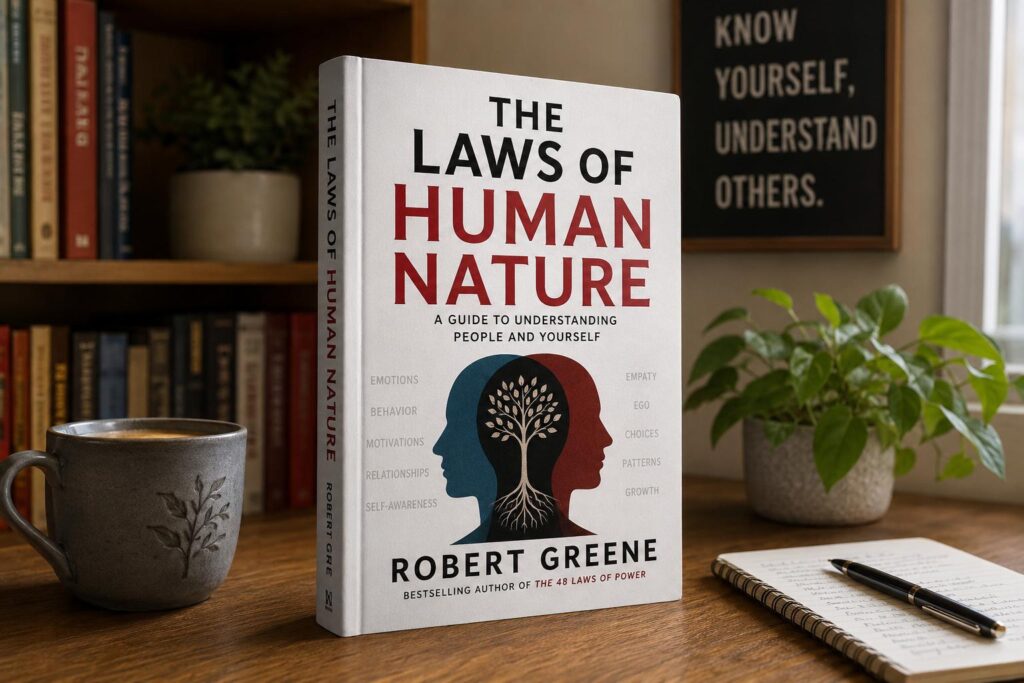
What is The Laws of Human Nature All About?
Everyone knows about Isaac Newton. He was an absolute genius. His laws changed Physics forever. But despite being a brilliant mind, he never understood human nature. He often misjudged human nature. Therefore, this is what he said about human nature: “I can calculate the motion of the heavenly bodies but not the madness of people.” Humans are the most complex creatures. Human nature is entirely different from all other living creatures because humans are the only creatures that have a lethal combination of wisdom and emotions, and this is what has been discussed in The Laws of Human Nature.
Why do intelligent people sometimes make irrational decisions? Why do people become defensive, jealous, envious, or overly influenced by the opinions of others? Why do some people repeat the same destructive patterns throughout their lives?
The book explores the psychological patterns that influence human behaviour and encourages readers to look more carefully at themselves and the people around them. Through historical examples, observations, and psychological ideas, Greene discusses the forces that can influence our decisions and relationships.
Understanding these patterns does not mean that we can perfectly predict every person or explain every action. Human beings are far too complex for that. However, greater self-awareness can help us recognise our own weaknesses, manage our emotions more effectively, make better decisions, and understand others more deeply.
Understanding human nature is also important for personal growth. The more honestly we examine our own behaviour, the better we can recognise the habits and emotional reactions that sometimes prevent us from moving forward.
Human behaviour is complex. Our actions are shaped not only by logic but also by emotions, experiences, desires, fears, and unconscious patterns.
This is the central idea behind The Laws of Human Nature by Robert Greene.
Understanding this combination is the key to mastering relationships, influence, and personal growth.
Who Is Robert Greene?
Robert Greene is one of the best authors. According to him, whoever understands human nature has a better chance of success. But how to understand human nature is a million-dollar question. This question has been answered brilliantly in the book “The Laws of Human Nature,” written by Robert Greene, which will blow your mind. Robert Greene is also the best-selling author of “The 48 Laws of Power“. But his book “The Laws of Human Nature” goes far beyond “The 48 Laws of Power”. Therefore, everyone must read it. It will give you such an understanding of human psychology and nature that you will cherish it all your life.
Robert Greene has given 18 laws of human nature in the book The Laws of Human Nature, but all the laws are equally significant.
1. Law of Irrationality: We Are Ruled by Emotions, Not Logic
We think today’s modern human beings are clever, intelligent, and rational, and make decisions based on wisdom, not emotions. But in reality, we make decisions based on emotions, not on rationality, and that’s why most of our decisions are incorrect.
Thousands of years ago, there was a famous statesman in Athens called Pericles. He used to spend time alone before making important decisions. After evaluating the consequences, he always made the best decision in the interest of the common masses. Therefore, people absolutely loved him. We can learn a lot from the passion and capital of Pericles. This is easy to say, but applying it practically is a challenge. Thinking objectively about any of the issues, one will face problems, and these problems are called biases.
Bias is a thought that has no logic or reason, and these biases are driven by our emotions and cognitive processes. There are dozens of biases in psychology, as per The Laws of Human Nature, like confirmation bias, conviction bias, group bias, appearance bias, superiority bias, blame bias, and so on. To make a sound and strong decision, one must know these biases to avoid falling into their trap.
Confirmation Bias: Whenever we decide whether in our professional or personal life, we search for evidence to make the best decision possible. But interestingly, we only search for the evidence that confirms our current belief. We wish the belief that lives in our minds should be acknowledged, which takes us away from the truth. Therefore, we tend to shun reality. Thus, to avoid confirmation bias, search for evidence that is entirely different from your existing belief. Be as skeptical as you can.
Conviction Bias: To a great extent, it is a self-explanatory bias. Conviction bias happens when you think, “I believe in this idea so strongly, it must be true”. Your conviction about the idea is so strong that you nullify and void the rest of the factors. Usually, when a political or religious leader talks to us with strong conviction and full authority, with heated words and gestures, it seems to us that whatever he says is 100% correct. But this is not always true. Therefore, one must always be careful.
Appearance Bias: According to this bias in The Laws of Human Nature, people are judged based on their outward appearance. But appearances can be really misleading. This is called the “Halo Effect” in the language of Psychology. The “Halo Effect” is when one trait of a person or thing is used to make an overall judgment of that person or thing.
We often assume that good-looking people are also kind and trustworthy, but this is not always true. This happens because we tend to fall for appearances. We judge people based on their physical and superficial appearance. We tend to judge someone’s inner qualities based on their outward appearance. Let’s remember that true beauty lies within. Therefore, it is essential to strive to understand individuals at a deeper level.
Group Bias: We do whatever the group endorses. This is also called the band-within-effect. We are social animals. Therefore, we don’t like isolation, and to belong to a group, we adopt its ideology, which is also called groupthink. On many occasions, our thoughts are different from those of the group, but we fear that if we voice our point of view, we might be ostracized. Therefore, we become the victims of this fear and calmly turn our heads in the direction where the group is headed.
Blame Bias: We often believe that we learn from our mistakes, but in reality, we tend to avoid or escape from them. Because it is too painful to look at our mistakes, and if a mistake occurs, we blame someone else for it. This is called self-serving bias in psychology. There is a saying, “Success has many fathers, while failure is an orphan”.
Superiority Bias: Because of this bias in The Laws of Human Nature, we think we are superior, decent, rational, and intelligent to others, but in reality, this is not so. We ignore our mistakes and shortcomings, which is the recipe for disaster. We have to create a balance between our emotions and rationality.
2. Law of Narcissism, Turning Self-Love into Empathy
“Narcissism” is a unique word in the English language that means self-love. A narcissist needs more praise, validation, and appreciation. Such people have the desire to be appreciated regularly. One should praise their hair, clothes, selfies, and gestures. Standing in front of a mirror and look at and praising themselves for hours. These are mild symptoms of narcissism. Instagram is full of this kind of personality disorder. But in reality, everyone is a narcissist at their own level. However, there is such a dangerous narcissism called Deep Narcissism.
It is dangerous because, within two to five years, it takes hold of our personality. This is the age when, for the first time, a child comes out of his mother’s lap and tries to discover his self-image. Parents should appreciate their child and give him time and attention at this age. This develops his positive self-image.
Deep narcissists can be identified by their behavior. They become furious with rage if you challenge them. They are oversensitive and usually consider themselves correct. In a relationship, deep narcissists view their partner as their extension and try to isolate their partners for better control. Our goal must be to invert narcissism into empathy, but what is empathy? Empathy means understanding and sharing others’ feelings. So that you can understand the situation of other people. You should know what their feelings and frustrations are. Be attentive to their needs and be a good listener. This will work wonders for you. If you develop these habits, you begin to understand the beauty of humanity.
3. Law of Role Playing: People Wear Masks Every Day
People indeed wear masks in daily life. This mask is worn to hide the real personality. Every person wants to look confident, intelligent, diligent, and attractive. Therefore, every person tries hard to hide jealousy, insecurity, and envy. If someone’s fake identity is accepted as real, their true feelings will never be known.
Fortunately, there are some cracks in this mask. Because of these cracks, people often express their real feelings, sentiments, and unconscious desires through body language or non-verbal cues unintentionally. Now, you must master this language to become an expert in reading people. People fall for appearances. Therefore, you can also fool people with your appearance to play with their emotions and perceptions. You can do your role-playing and do it to favor your cause.
Otherwise, his self-image will be distorted, and from this point, deep narcissism begins. Usually, parents of such children are self-narcissists and snub their personalities while trying to control them. Such children develop strange personalities as they grow. Children with this personality type need constant exposure to new people, environments, praise, appreciation, and attention. Conversely, introverted children of this type often seem detached or lost in their own world. They may also feel superior or isolated, and many are at risk of developing drug addiction.
4. Law of Compulsive Behaviour, Strong vs Toxic Character
According to this law in The Laws of Human Nature, we should measure the strength of people’s character. Because character is the thing that one never loses. You will know if a person has a loose character or a deep character in due course of time.
Therefore, if you want to know the real behavior of people, then try to know their true character. This will give you insights into their personalities that nothing else can give you. If you want to judge the character of someone, then note how they react in times of adversity. People of strong character always face hardships with responsibility. This is a sign of strength. However, on the other hand, there will be toxic people whose responses will be the opposite. But these toxic people are also of various types.
Initially, you will be impressed by the Hyper Perfectionist’s behavior as they strive for excellence in everything they do to maintain the highest standard. But with time, you will discover that the story is different. They are perfectionists because they don’t know how to delegate. They trust no one. Therefore, always watch these sorts of individuals and deal with them accordingly.
There is another type of toxic people known as Relentless Rebels. Initially, living with such people may seem exciting because they are known for rebelling against authority and going against the system. They also tend to have a great sense of humor, which attracts people to them. But if you scratch the surface, they have insecure personalities under a rebellious nature. These types of people are usually maltreated by their parents in their childhood. That’s why they tend to hate power and authority. Therefore, be very careful with the rebels you meet in your life.
The Personalizer is another type of toxic person. They are thoughtful and sensitive. They seem intelligent, and they are usually good to work with. But with time, it becomes clear that their sensitivity is only for themselves. Their sensitivity is only directed inward. If you do anything wrong with them, they will remember it for months and years, and make sure you remember it too. They also present themselves as victims. That’s why their personalities eventually become toxic.
Then you will meet some Drama Magnets who always remain busy with it. They possess unusual energy. They have dozens of stories to tell. Their features are very animated. You will enjoy talking to them. But a time comes when their drama becomes ugly, and they show you their real face. These kinds of people will ensnare you in their drama in such a way that you will never be able to escape.
Then come the “Big Talkers“. These people tend to speak grandiosely, but deep inside their personalities, there is no substance. These people never complete any work and eventually blame others for it.
The Savior is another kind of toxic individual. You believe that, at last, you have discovered the individual you have been searching for. This person will give you acquittal from all your problems, but in reality, he will control you. Whenever you try to be independent, he depresses your personality, and he becomes quite aggressive. You think that he is a solution to all your problems, but actually, he is the real problem.
You will meet a lot of such toxic people in your life. The primary intention of discussing them is to prevent encountering them. Do not demean or belittle them, but observe them. Be very careful and always tilt toward people of strong character.
5. Law of Covetousness: Become an Object of Desire
According to this law in The Laws of Human Nature, we should make ourselves an object of desire, but how do we achieve it? It is a question of concern. If you constantly show up everywhere and every time, you will gradually lose your dignity and value. Make sure to be selective and intentional about where and when you present yourself.

That is the reason the big celebrities or stars limit their attendance. They are seen rarely. They create a mystery around them. Therefore, it is essential to use strategic absence to make people desire your return. Conduct yourself in a way that people want to possess you, but never let them know who will possess you. The people must be shown the thing they desire. They will become your crazy lovers, and you will be a timeless dream for them. Most people indeed live their lives in a narrow timeframe.
In the context of time, our emotions tend to be negative, as it reminds us of aging and an uncertain future. So, we are petrified of time. We always fall for short-term things, which is one of the biggest mistakes in our lives. We never focus on the big picture. Instead of long-term thinking, we focus on low-hanging fruit. Due to this, though we get short-term joy, we never get long-term success.
6. Law of Short-Sightedness: Focus on the Long Term
Most people lack perseverance. Perseverance is such a superpower that makes you successful in life. If we read the life stories of successful people, we find one common thing in their lives: long-term dedication. This is one of the most essential qualities to differentiate between a champion and a mediocre individual.
7. Law of Defensiveness: How to Persuade Without Offending
When you go to bring about a change in people, people will resist. People usually never like change. They tend to resist when you try to change them. Now, what to do in such a situation?
We make a mistake when we try to convince others. We enforce our opinion on them, which is absolutely wrong. Because people think their free will is being attacked. They don’t feel independent. Focus on people if you want to change them. Give them importance. Listen to them. Make them feel important. Let them do the talking. Do not hesitate to take an inferior position to make the others seem superior. When you win their trust, they will play in your hands. They will do what you want them to do.
French Philosopher Jean De La Bruyère has said a wonderful thing about conversation with the people, “The true spirit of conversation consists more in bringing out the cleverness of others than in showing a great deal of it yourself: he who goes away pleased with himself and his own wit is also pleased with you. Most men seek less to be instructed, and even to be amused, than to be praised and applauded”. How to persuade people is a big question. For it, there are five strategies:-
First, you have to develop yourself as an expert listener. There is a reason why we have been given one tongue and two ears. Remember, everyone loves to be heard, and if you become that listener, this listening power will make you an expert persuader.
The second strategy is to infect people with a good mood. The mood of the people should be good after meeting you. You should radiate positive vibes, because of which people will be eager to meet you.
The third strategy is to confirm their self-opinion. Make people the center of attraction rather than making yourself. Give them autonomy and win them with your goodness.
The fourth strategy is to allay the insecurities of people. Every person is insecure somehow concerning looks, creative power, masculinity, power status, uniqueness, or popularity, etc. You must protect them from such kinds of insecurities.
The fifth strategy is to use people’s resistance and stubbornness in your favor. There may be some individuals in your life who are headstrong. They may be more resistant to change. They often do the opposite of what people say to them. First, they will ask for advice. Then, they will point out dozens of flaws in your advice. You should play mental judo with such kinds of people. Use their emotions, their language, and their rigidity in your favor. If you tell him what he is doing is right, he will go the opposite way. Because you have advised him, and with the advice, he never agrees, as he is a rebellious soul.
8. The Law of Self-Sabotage: Your Attitude Defines Your Life
Every person has a different ideology to view the world. This ideology can build or destroy our lives. Remember, attitude is directly proportional to achievement. Therefore, what you achieve in life is the result of your attitude. Life returns exactly what your attitude is. Being a pessimist can lead to negative outcomes, but if you are an optimist and always look at the brighter side of things, things will always fall into place for you.
Therefore, it’s important to remember that your attitude can have a significant impact on your personal growth. Don’t let a negative attitude sabotage your progress. Explore the limits of your willpower, and you will be surprised at how far your willpower will take you in life. A negative and toxic person not only harms himself but also those around him. A negative person also has a negative influence on their team.
There are a lot of categories of negative people discussed in The Laws of Human Nature. Some have hostile attitudes. Such people spread hatred all around. Some have anxious attitudes. These individuals tend to focus on problems in every aspect of their lives. They are always suffering from excusitis. Some people have avoidant attitudes. Such kind of people hesitate to take responsibility. Some people have a depressive attitude. These people always remain anxious even on the most joyous occasions.
Arthur Schopenhauer has said beautifully, “This is why the same external events or circumstances affect no two people alike; even with perfectly similar surroundings, everyone lives in a world of his own. The world in which a man lives shapes itself chiefly by the way in which he looks at it, and so it proves different to different men. To one, it is barren, dull, and superficial: to another, rich, interesting, and full of meaning.
On hearing of the interesting events that have happened in the course of man’s experience, many people will wish that similar things had happened in their lives too, completely forgetting that they should be envious rather than the mental aptitude which lent those events the significance they possess when he describes them”.
Remember, your thoughts become things.
9. The Law of Repression: Confront Your Dark Side
Every human being has qualities that they prefer not to show to others. We may hide our anger, jealousy, insecurity, selfishness, ambition, resentment, or desire for recognition because these feelings do not fit the image we want to present. Robert Greene refers to this hidden side as the dark side.
The problem is that simply refusing to acknowledge these feelings does not necessarily make them disappear. Sometimes, the emotions we deny can influence our behaviour without our full awareness.
For example, a person may believe that they are not jealous but become unusually critical whenever someone else succeeds. Another person may believe that they are always calm but repeatedly express hidden anger through sarcasm or passive-aggressive behaviour. The purpose of confronting our dark side is not to become negative about ourselves. It is to become more honest.
Accept That You Are Not Perfect
Everyone has weaknesses. Everyone has moments of envy, anger, insecurity, or selfishness. Pretending that these emotions do not exist can make it more difficult to manage them. A wiser approach is to recognise them when they appear.
Instead of saying:
“I never feel jealous.”
you might honestly ask:
“Why does this person’s success make me uncomfortable?”
Instead of saying:
“I am not angry.”
ask:
“Why am I reacting so strongly?”
This kind of self-questioning can reveal emotions that we would otherwise ignore.
Self-Observation Creates Control
You cannot control an emotion that you refuse to recognise. When we become aware of our negative patterns, we gain a better opportunity to manage them. For example, recognising anger may help us pause before saying something harmful. Recognising envy may help us understand our own unmet ambitions. Recognising insecurity may encourage us to work on genuine self-confidence instead of constantly seeking approval.
The Law of Repression teaches us that self-knowledge requires honesty. We should not create a perfect image of ourselves and believe it completely. Instead, we should examine both our strengths and our weaknesses. The more honestly we understand ourselves, the less likely our hidden emotions are to control us without our awareness.
10. The Law of Envy: Beware the Fragile Ego
Envy is one of the most common but least openly discussed human emotions. People may openly admit that they are tired, angry, or disappointed. But very few people comfortably say:
“I am jealous of that person.”
This is because envy can make us feel uncomfortable about ourselves. We may see another person’s success and immediately compare it with our own life.
Someone else receives recognition.
Someone else earns more money.
Someone else achieves the position we wanted.
Someone else appears to have the life we dream about.
These comparisons can create resentment. Robert Greene explains that envy often becomes stronger among people who are close to us or similar to us. We may not compare ourselves seriously with a distant celebrity, but we may feel deeply affected when a colleague, friend, neighbour, or relative achieves something that we wanted.
Envy Can Hide Behind Other Emotions
Envy is not always obvious. Sometimes it can appear as unnecessary criticism. A person may constantly point out the weaknesses of someone successful. They may reduce another person’s achievement to luck.
They may say:
“He was just in the right place at the right time.”
Or:
“She is not really that talented.”
Sometimes criticism is fair and necessary. However, we should also recognise that envy can sometimes hide behind constant attempts to reduce another person’s success.
Use Envy as a Source of Self-Knowledge
The healthiest response to envy is not to deny it. Instead, try to understand it.
Ask yourself:
“Why does this person’s success affect me?”
The answer may reveal something important. Perhaps they have achieved something you secretly want. Perhaps their success reminds you of a goal you have ignored. Perhaps you are unhappy with your own progress.
Instead of allowing envy to become resentment, use it as information.
If you envy someone’s writing ability, perhaps you want to become a better writer.
If you envy someone’s career, perhaps you need to develop your own skills.
If you envy someone’s confidence, perhaps you need to work on trusting yourself.
In this way, envy can reveal our hidden desires. The important thing is not to allow comparison to destroy our peace.
Another person’s success does not automatically mean your failure.
Everyone follows a different path, and progress does not happen at the same speed for everyone.
11. The Law of Grandiosity: Know Your Limits
Confidence is important. Without confidence, people may never take risks, start businesses, develop new ideas, or attempt difficult goals. But confidence can become dangerous when it turns into grandiosity. Grandiosity occurs when we develop an exaggerated belief in our own importance, abilities, or knowledge.
We may begin to believe that we cannot fail. We may stop listening to criticism. We may assume that ordinary rules apply to everyone except us. This can lead to serious mistakes.
History contains many examples of powerful people who became so confident in their own judgment that they ignored warnings and eventually made disastrous decisions. The problem was not confidence itself. The problem was the loss of perspective.
Success Can Sometimes Create Overconfidence
One of the most dangerous moments can come after success. When something works repeatedly, we may begin to believe that every future decision will also succeed. We may forget the role of timing, teamwork, preparation, opportunity, and even luck. This can make us careless. The Law of Grandiosity reminds us to remain connected with reality.
Ask yourself:
“What do I actually know?”
“What am I assuming?”
“What am I ignoring?”
“Who can give me honest feedback?”
These questions can protect us from becoming trapped by our own confidence.
Ambition Needs Reality
There is nothing wrong with having big dreams. You should aim high. You should work toward meaningful goals. But ambition becomes more powerful when it is combined with realistic planning and continuous learning.
Know your strengths.
Know your weaknesses.
Understand what you do not yet know. And never believe that success has made you incapable of making mistakes.
Confidence helps us begin, but humility helps us continue learning.
12. The Law of Gender Rigidity: Reconnect to Your Masculine or Feminine Side
Robert Greene’s twelfth law discusses what he describes as gender rigidity and encourages readers to develop a wider range of human qualities instead of becoming trapped in a narrow image of how they are supposed to behave.
This idea can be understood practically. Society often creates expectations about how people should behave. Some qualities may traditionally be described as masculine, such as assertiveness, courage, and independence. Others may traditionally be described as feminine, such as empathy, patience, sensitivity, and cooperation.
However, human beings are more complex than rigid categories.
A strong person can also be compassionate.
An independent person can also know when to ask for help.
A sensitive person can also be courageous.
A leader can combine confidence with empathy.
The practical lesson is not that one group of qualities belongs exclusively to one gender. Rather, people can benefit from developing different strengths when the situation requires them.
Develop a Wider Range of Qualities
Life requires flexibility.
Sometimes you need courage.
Sometimes you need patience.
Sometimes you need to lead.
Sometimes you need to listen.
Sometimes you need to be firm.
Sometimes you need to be compassionate.
A person who develops only one side of their personality may struggle when life demands a different response. For example, excessive aggression can damage relationships, but excessive passivity can make it difficult to protect your boundaries.
The goal is balance.
Learn when to be strong and when to be gentle.
Learn when to speak and when to listen.
Learn when to compete and when to cooperate.
This makes us more adaptable and emotionally mature. The lesson from this law is to avoid allowing narrow expectations to limit your personal growth.
Develop the qualities that help you become a wiser, more balanced, and more complete human being.
13. The Law of Aimlessness: Advance with a Sense of Purpose
One of the greatest difficulties in life is not always a lack of ability. Sometimes, it is a lack of direction. Many people have talent, intelligence, and opportunities, yet they feel uncertain about where they are going. They move from one interest to another, change their goals repeatedly, and allow circumstances or other people’s expectations to determine the direction of their lives.
Robert Greene’s Law of Aimlessness encourages us to develop a stronger sense of purpose. Having a purpose does not mean that you must know every detail of your future. Life changes, and our goals can also change with experience. However, having a general direction can help us make better decisions.
Ask yourself:
What kind of work interests me deeply?
What skills do I want to develop?
What problems would I like to solve?
What kind of person do I want to become?
These questions can help us move beyond simply reacting to whatever happens around us.
Purpose Gives Direction to Effort
Without a sense of direction, it is easy to become distracted. One day, we may want to become successful in one field. The next day, we see someone else succeeding in a different field and suddenly want to follow that path instead.
Constantly changing direction can make it difficult to develop real expertise. This does not mean that you should never change your plans. Sometimes changing direction is necessary and wise.
The important thing is to avoid making every decision based on temporary excitement, fear, or the latest trend. A sense of purpose helps us decide what deserves our time and attention.
Discovering Your Direction
Purpose is not always discovered in a single moment. For many people, it develops gradually.
You learn what interests you by exploring.
You discover your strengths by practising.
You understand your weaknesses by making mistakes.
You gain clarity through experience.
Therefore, do not become discouraged if you have not discovered a perfect life purpose yet. Start by paying attention to the activities that genuinely interest you and the skills you enjoy developing.
Then take small steps.
Learn.
Practice.
Experiment.
Improve.
Over time, a clearer direction may emerge.
The lesson of this law is to avoid drifting through life without reflection.
A meaningful purpose gives direction to your energy and helps you focus your efforts on what truly matters to you.
14. The Law of Conformity: Resist the Downward Pull of the Group
Human beings are strongly influenced by the people around them.
We want to belong.
We want acceptance.
We often want to avoid criticism, rejection, or isolation.
Because of this, groups can influence our thoughts and behaviour more than we realise. Sometimes this influence is positive. A good group can encourage learning, discipline, kindness, and growth. However, groups can also encourage poor decisions. A person who would never behave badly alone may do so when surrounded by people who support or normalise that behaviour. This is why it is important to understand the power of conformity.
Do Not Follow the Crowd Blindly
Just because many people believe something does not automatically make it correct.
Just because something is popular does not mean that it is beneficial.
We should learn to ask:
“What do I actually think?”
“Do I agree with this because I believe it is right, or because I am afraid to disagree?”
Independent thinking does not mean opposing everyone. It does not mean believing that you are always smarter than the group. It simply means examining ideas for yourself instead of accepting them blindly.
Choose Your Environment Carefully
The people around us can influence our habits and ambitions. If you spend time with people who constantly discourage learning, improvement, or discipline, you may eventually begin to accept their attitude. On the other hand, being surrounded by people who encourage growth can motivate you to improve.
This does not mean that we should abandon friends or judge people as superior or inferior. It means being aware of the influence that our environment can have on us. Choose communities that encourage your better qualities. Spend time with people who respect your goals. And when a group pressures you to act against your values, dare to think independently.
Belonging to a group is natural, but losing your ability to think for yourself can be dangerous.
15. The Law of Fickleness: Make Them Want to Follow You
People’s attention and emotions can change quickly. Someone may be enthusiastic today and uninterested tomorrow. A group may support an idea when everything is going well but lose confidence when difficulties appear. This is part of the unpredictability of human behaviour.
Robert Greene’s fifteenth law explores leadership and the challenge of maintaining people’s interest and commitment. The practical lesson for everyday life is not to manipulate people’s emotions. Instead, it is to understand that leadership requires more than giving orders. People are more likely to follow someone when they trust that person, understand the purpose behind their actions, and feel respected.
Leadership Requires Connection
A good leader should understand the people they lead.
What are their concerns?
What motivates them?
What problems are they facing?
What are they hoping to achieve?
A leader who never listens may eventually lose the trust of the people around them. This applies not only to political or business leaders but also to teachers, managers, parents, coaches, and anyone responsible for guiding others.
Inspire Through Actions
Words can motivate people for a short time. But actions create deeper trust.
If a leader expects discipline but behaves carelessly, people may lose respect.
If a leader demands honesty but lies, trust can disappear.
If a leader asks others to work hard but refuses to make sacrifices, their words may lose their power.
People often pay close attention to what leaders do. Therefore, one of the best ways to influence others positively is to demonstrate the behaviour you expect from them.
Be consistent.
Keep your promises whenever possible.
Accept responsibility for mistakes.
Give people credit for their contributions.
Treat others with respect.
These qualities can create a stronger and more lasting influence than manipulation or fear.
The lesson of this law is that people may change their minds, but trust can be strengthened through consistent behaviour, clear purpose, and respectful leadership.
16. The Law of Aggression: See the Hostility Behind the Façade
Not all aggression is obvious. Some people openly express anger and hostility. Their behaviour is easy to recognise. But aggression can also appear in quieter forms. A person may smile while repeatedly undermining you. They may offer advice that is actually designed to discourage you. They may use sarcasm, humiliation, or constant criticism. They may pretend to support you while secretly creating difficulties.
Robert Greene’s Law of Aggression encourages readers to pay attention to patterns instead of judging people only by pleasant appearances. This does not mean that we should become paranoid or assume that everyone has hidden bad intentions. Suspicion can damage relationships just as easily as blind trust. The wiser approach is to remain observant.
Pay Attention to Repeated Behaviour
A single unpleasant comment does not define a person’s character. Everyone can have a bad day. Everyone can make a mistake. But repeated behaviour deserves attention. If someone repeatedly humiliates you, ignores your boundaries, creates unnecessary conflict, or tries to weaken your confidence, it may be necessary to examine the relationship more carefully.
Ask yourself:
“How do I usually feel after interacting with this person?”
“Does this person respect my boundaries?”
“Are their actions consistent with their words?”
“Is this a single incident or a repeated pattern?”
These questions can help us see relationships more clearly.
Respond Wisely Instead of Reacting Emotionally
When we feel attacked, our first reaction may be anger. But immediate emotional reactions can sometimes make the situation worse. Instead, pause and assess what is happening. Not every disagreement is aggression. Not every criticism is an attack. Constructive criticism can help us grow.
However, repeated hostility, manipulation, or disrespect should not be ignored. The goal is to remain calm, establish appropriate boundaries, and make thoughtful decisions about how much access certain people should have to your life.
Understanding aggression does not mean living in fear. It means developing the awareness to recognise unhealthy patterns and the confidence to respond wisely.
17. The Law of Generational Myopia: Contemplate the Future
Every generation is influenced by the time in which it lives. We are shaped by the technology, culture, economic conditions, social changes, and major events around us. Because we are living inside our own time, it can be difficult to see the bigger historical picture. We may believe that the way people think today will remain the same forever.
But history shows that societies constantly change. Ideas that once appeared permanent can disappear. Technologies can transform the way people work and communicate. New generations can challenge old assumptions and create different values. Robert Greene’s seventeenth law encourages us to think beyond the present moment and consider long-term historical change.
Learn From the Past
Studying history can help us understand that many human problems and patterns are not entirely new. Different generations may experience similar struggles in different forms.
Power changes hands.
Economic conditions rise and fall.
Technologies create new opportunities and new challenges.
Social values evolve.
Understanding these patterns can help us become less trapped by the idea that the present moment is the only thing that matters.
Think Beyond Your Own Generation
It is easy to focus only on what affects us immediately. But our decisions can influence the people who come after us. This is particularly important when thinking about education, the environment, technology, society, and long-term development.
Ask yourself:
“What consequences could this decision have in the future?”
“Am I thinking only about today?”
“What kind of world are we helping to create?”
No one can predict the future perfectly. However, thinking about possible long-term consequences can make us wiser and more responsible. The lesson of this law is to avoid becoming completely trapped by the trends and emotions of the present.
Look at the past. Understand the present. And think carefully about the future.
18. The Law of Death Denial: Contemplate Our Common Mortality
Death is one of the most difficult realities of human life. Most people do not like to think about it. We plan for the future, pursue success, build relationships, and often behave as if we have unlimited time.
Robert Greene’s final law encourages us to face the reality of mortality instead of avoiding it completely. At first, this may sound like a dark or depressing idea. However, reflecting on the limited nature of life can also help us appreciate it more deeply.
Life Is Valuable Because Time Is Limited
If we believed that we had unlimited time, we might postpone everything. We might endlessly delay meaningful goals. We might continue holding unnecessary grudges. We might avoid saying important things to the people we love.
But the reality that time is limited can remind us that our choices matter.
What are we doing with our time?
What relationships matter most to us?
What kind of contribution do we want to make?
What dreams have we postponed without a good reason?
These questions can encourage us to live more consciously.
Accepting Mortality Can Change Our Priorities
Many things that seem extremely important today may not matter much when viewed from a larger perspective.
A small argument.
A temporary embarrassment.
Someone else’s opinion.
A minor failure.
Reflecting on life’s limited nature can help us distinguish between what is truly important and what is simply consuming our attention. This does not mean that we should stop planning for the future.
Quite the opposite.
It means appreciating the present while using our time wisely. We cannot control how long we live, but we can make thoughtful decisions about how we live. The final lesson of The Laws of Human Nature is powerful:
When we accept that life is temporary, we may become more grateful for the time, people, and opportunities we have today.
Key Lessons From The Laws of Human Nature
The Laws of Human Nature contains many ideas, historical examples, and observations. However, several central lessons can be applied to everyday life.
1. Understand Your Emotions Before They Control You
Emotions are a natural part of human life, but strong emotions can influence our judgment. Pause before making important decisions when you are extremely angry, afraid, excited, or upset.
2. Recognise Your Biases
We all have blind spots. Be willing to question your assumptions and consider evidence that challenges your opinions.
3. Observe Actions, Not Only Words
People can make promises and create impressive images. Repeated behaviour over time often provides more useful character information.
4. Develop Empathy
Try to understand the experiences and perspectives of other people. Empathy can improve communication and relationships.
5. Recognise Your Own Weaknesses
Self-awareness is impossible if we only see our strengths. Be honest about your fears, insecurities, habits, and emotional reactions.
6. Think Long Term
Do not sacrifice an important future goal merely for temporary pleasure or a quick reward. Patience and consistent effort often produce better results than the constant search for instant success.
7. Avoid Unnecessary Comparison
Another person’s success does not reduce your own potential. Instead of allowing envy to become resentment, use it to understand what you genuinely want to achieve.
8. Remain Confident but Humble
Confidence helps you act. Humility helps you learn. The strongest approach is to combine ambition with the willingness to accept feedback and correct mistakes.
9. Choose Your Environment Carefully
The people and communities around you can influence your habits and decisions. Try to spend time in environments that encourage learning, growth, and positive behaviour.
10. Develop a Sense of Purpose
You may not have every answer about your future, but having a meaningful direction can help you use your time and energy more wisely.
11. Establish Healthy Boundaries
Understanding people does not mean tolerating repeated disrespect or harmful behaviour. Observe patterns, protect your boundaries, and make thoughtful decisions about your relationships.
12. Remember That Time Is Limited
Use your time carefully. Appreciate meaningful relationships. Continue learning. Do not postpone every important goal while waiting for a perfect moment.
The Laws of Human Nature vs The 48 Laws of Power
Robert Greene became a global name after writing The 48 Laws of Power. That book focuses on how power operates in the real world, how people gain it, use it, and sometimes misuse it. It teaches strategies to protect yourself from manipulation and to navigate competitive environments.
However, The Laws of Human Nature go much deeper. While The 48 Laws of Power deals with the external world of power, The Laws of Human Nature deals with the internal world of psychology and emotions. It helps us understand why people behave the way they do, the hidden motives, fears, and desires that drive every action.
If The 48 Laws of Power teaches you how to deal with others, The Laws of Human Nature teaches you how to understand them. One shows you how to play the game of power; the other shows you what’s happening inside the players. Therefore, both are masterpieces in their own way, but The Laws of Human Nature takes you one step closer to self-mastery.
Final Thoughts
Human beings are complex.
We are logical, but also emotional.
We can be confident, yet insecure.
We want independence, yet also want acceptance.
We can show kindness while struggling with envy, anger, fear, or self-doubt.
This complexity is what makes the study of human nature so fascinating. The Laws of Human Nature encourages us to look beyond simple appearances and examine the emotions, habits, biases, and repeated patterns that influence behaviour. Perhaps the most important lesson is that understanding human nature should begin with understanding ourselves.
Before judging the irrationality of others, examine your own emotions.
Before criticising another person’s weaknesses, recognise your own blind spots.
Before trying to influence others, learn to listen.
Before reacting, pause and think.
And before allowing temporary emotions to control your decisions, try to understand where those emotions are coming from. The purpose of learning about human nature is not to become suspicious of everyone or to believe that we can perfectly predict people. Instead, it is to become more observant, self-aware, empathetic, and thoughtful.
The Laws of Human Nature is not just a book; it’s a mirror that reflects who we truly are. It helps us understand the hidden forces that control our behavior and shape our relationships. Once you begin to see through people’s masks and understand their emotions, life becomes less confusing and more meaningful.
Robert Greene’s message is clear in his book “The Laws of Human Nature”: the greatest power of all is self-awareness. The more you understand human nature, the better decisions you make, the wiser you become, and the more peaceful your life turns out to be.
So, if you really wish to understand yourself and others, read The Laws of Human Nature. It will open your eyes to the truth about people, emotions, and life itself. Remember, wisdom begins when we start observing not the world outside, but the world within.
The better we understand ourselves, the better prepared we may be to understand the complex world of human behaviour around us.