ENGLISH TENSE SYSTEM
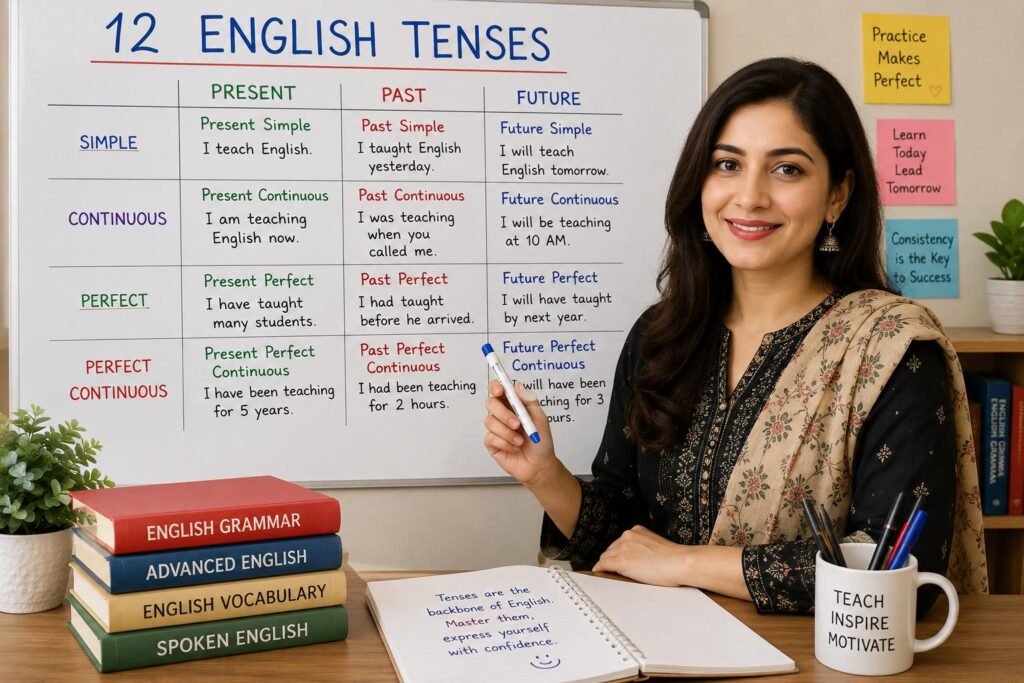
Every English sentence tells not only what happened but also when it happened. English tenses allow us to express whether an action is taking place now, happened in the past, or will happen in the future. Mastering English tenses is one of the most important steps toward speaking and writing English confidently.
English tenses are the building blocks of the English language. One can’t progress if one doesn’t know them. The English language has two main tenses, the present (clean, wash, go) and the past (cleaned, washed, went) Auxiliary verbs make all other expressions by combining with the present participle, past participle, or infinitive, as in the progressive or continuous aspect (I was cleaning the kitchen), the perfect or perfective part (She has washed the clothes), and the future (They will go to school).
However, they are commonly known as English tenses. They are pivotal in conveying the timing of actions and events in a sentence. In this comprehensive guide, we will delve deep into the world of English tenses, exploring all 16 of them. By the end of this article, you will have a clear understanding of how to use each tense effectively, whether you are writing, speaking, or simply trying to grasp the intricacies of English Grammar.
Explore Why Harvard University Remains the Dream University for Millions
| Tense | Example |
|---|---|
| Present Simple | I study English. |
| Present Continuous | I am studying English. |
| Present Perfect | I have studied English. |
| Present Perfect Continuous | I have been studying English. |
| Past Simple | I studied English. |
| Past Continuous | I was studying English. |
| Past Perfect | I had studied English. |
| Past Perfect Continuous | I had been studying English. |
| Future Simple | I will study English. |
| Future Continuous | I will be studying English. |
| Future Perfect | I will have studied English. |
| Future Perfect Continuous | I will have been studying English. |
TENSE AND TIME
Past ←──────── Present ────────→ Future
In this blog, we have explained the difference between time and tense by giving different situations. For instance, Simple Present Tense is not only used for the present time but may also be used for the future. Therefore, time and tense should not be confused.
Are There 12 or 16 Tenses in English?
Traditional English grammar teaches 12 tenses (Present, Past, Future × 4 aspects).
Some grammar books also include 4 conditional forms in the English language, bringing the total to 16, but these are generally considered conditional constructions rather than basic tenses.
BASIC TENSES
There are 16 basic English tenses. We have discussed the ins and outs of each tense. The usages and structures have been explained with examples and formulae in a unique and accessible style to understand all the 16 basic English tenses. But if we follow the common trend, we know that the tense is divided into three basic forms, i.e., Present, Past, and Future. Each state has four further subforms. Besides, there are four conditional tenses. All 16 tenses are as follows:-
Learn how to Speak English Fluently, Click Here
PRESENT TENSE
1. Simple Present Tense (also called Present Indefinite Tense)
2. Present Progressive Tense (also called Present Continuous Tense)
3. Present Perfect Tense
4. Present Perfect Progressive Tense (also known as present perfect continuous tense)
PAST TENSE
1. Simple Past Tense (also called Past Indefinite Tense)
2. Past Progressive Tense (also called Past Continuous Tense)
3. Past Perfect Tense
4. Past Perfect Progressive Tense (also called Past Perfect Continuous Tense)
FUTURE TENSE
1. Simple Future Tense (also called Future Indefinite Tense)
2. Future Progressive Tense (also called Future Continuous Tense)
3. Future Perfect Tense
4. Future Perfect Continuous Tense (also called Future Perfect Progressive Tense)
CONDITIONALS
1. Conditional Simple
2. Conditional Continuous
3. Conditional Perfect
4. Conditional Perfect Continuous
Mastering the 16 tenses of the English Language can greatly enhance your communication skills. Whether you are a writer, speaker, or language enthusiast, a firm grasp of these tenses allows you to convey precise meanings and subtle nuances in your expressions.
Frequently Asked Questions
Why are tenses important in English?
Tenses are essential in English as they provide a framework for expressing the timing of actions, events, and ideas, thus ensuring clear and effective communication.
Can I mix different tenses in a sentence?
While it’s possible to use different tenses in a sentence, it should be done judiciously to avoid confusion. It often depends on the context and the message you want to convey.
What is the most challenging tense to master?
Many learners find the subjunctive tenses, particularly the past subjunctive, to be challenging due to their specific usage in expressing doubt, wishes, or suggestions.
Are there variations in tenses in different English dialects?
Yes, some dialects and regional variations may have unique expressions of tenses, but the fundamental tenses remain consistent across English
How can I practice using tenses effectively?
To practice using tenses effectively, read and write regularly, and consider seeking guidance from language resources, courses, or native speakers.