

Cloud computing has quietly become one of the most incredible technologies of the modern world. Whether you are a student saving assignments, a business managing operations, or simply someone streaming videos, the cloud is working behind the scenes.
Although many people use it, few understand what “the cloud” is.
In this post, we will take you beyond basic definitions. You will learn a clear, practical, and deeply insightful understanding of cloud computing, from its origins to its real-world applications and future.
1. The definition of the Cloud
Cloud Computing is the delivery of computing services over the internet. These services include:
- Data storage
- Servers
- Databases
- Networking
- Software applications
Instead of storing everything on your personal devices, such as a computer or phone, cloud computing lets you store and access data on remote servers.
A simple way to understand Cloud Computing
Consider your device as a small backpack with limited space. The cloud, in contrast, resembles a vast warehouse where you can store unlimited items and access them whenever needed.
The following are some of the main key characteristics of Cloud Computing
- One of the most important characteristics is On-Demand Access. One can access resources
You can access resources whenever you need them. - Remote Storage is another key characteristic. Data is stored in secure data centers across the world.
- Scalability is a characteristic of cloud computing that allows for easy adjustments to storage and computing power.
- The pay-as-you-go model is a feature of cloud computing in which service charges depend on usage rather than fixed costs.
Real-life example of cloud computing
When you upload a file to Google Drive, it is stored on remote servers, not on your device. You can access it from any device, anywhere in the world.
2. History of the Cloud
Cloud computing might seem like a recent innovation, but its origins date back several decades.
The early vision of the 1960s
Cloud computing originated from the concept of shared computing resources, proposed by John McCarthy, who envisioned that computing could function like a utility such as electricity.
At that time, computers were massive and expensive, so sharing resources made practical sense.
The internet era of the 1990s
With the growth of the internet, companies began offering services remotely instead of requiring users to install software locally. Online services became tremendously popular due to their incredible use.
This was the foundation of what would later become cloud computing.
The birth of modern cloud in the 2000s
World-renowned companies like Amazon revolutionized the industry of cloud computing by launching cloud infrastructure services.
Soon after, Google and Microsoft entered the race, making cloud computing mainstream in the digital world.
Today’s cloud computing era
Today, cloud computing powers the following:
- Social media platforms
- Online education systems
- Streaming services
- Business operations worldwide
Therefore, cloud computing has now become the backbone of the digital economy.
3. The Cloud in Numbers
Real-world statistics help to understand the global impact of cloud computing.
Global Adoption
- More than 90% of organizations worldwide use cloud computing services.
- Every day, millions of developers harness the power of cloud platforms to build innovative applications that transform industries.
Market Growth
- The cloud computing industry is currently valued at hundreds of billions of dollars worldwide.
- It continues to grow rapidly every year
Data Explosion
- Over 2.5 quintillion bytes of data are created in cloud computing every day.
- Most of this data is stored and processed daily in cloud computing.
Everyday Usage
- Billions of users rely on cloud-powered apps
- Almost every modern website uses cloud infrastructure
These numbers reveal a powerful truth that cloud computing is no longer optional. It is essential.
4. Types of Cloud Services
There are three major service models of cloud computing. Understanding them is the key to knowing how the cloud works.
Infrastructure as a Service (IaaS)
This is the most basic level of cloud computing.
It provides:
- Virtual servers
- Storage
- Networking
Businesses worldwide rent these resources rather than buy physical hardware, so a startup can launch a website without purchasing expensive servers.
Platform as a Service (PaaS)
Developers use this model to build and deploy applications, which include:
- Development tools
- Operating systems
- Databases
Developers can focus on coding without worrying about infrastructure, which is one of the amazing advantages of this model.
Software as a Service (SaaS)
This is the most common type of model for everyday users, as they use it extensively. The software is delivered via the internet.
Examples:
- Gmail, launched by Google in 2004, is a free web-based service known for its large storage, powerful search capabilities, and advanced spam filtering.
- Google Docs is a free, web-based word processor by Google that allows real-time document creation, editing, and collaboration. It offers automatic saving to Google Drive, sharing options, revision history, and compatibility with Microsoft Word.
These are online services. No installation is required, just open and use it.
5. Cloud Problems
As you know, everything has its pros and cons. Despite its advantages, cloud computing is not perfect. It has its own challenges, and understanding its challenges helps you use it wisely.
Security Risks
Storing data online increases the risk of hacking. Intruders are prevalent in the digital world. Providers implement strong security measures, but risks remain.
Internet Dependency
Cloud services require internet access. Without the internet, cloud services cannot be used when your data becomes inaccessible.
Privacy Concerns
In today’s digital landscape, true confidentiality is virtually impossible. Your data resides on third-party servers, leading to significant concerns about who controls it and how securely it’s protected.
Downtime
Even the largest cloud providers are not immune to outages, and these disruptions can temporarily interrupt services, creating significant embarrassment for businesses dependent on them.
Balanced View
The cloud offers immense power and potential, but it also requires mindful usage and a clear understanding to maximize its benefits.
6. Why Cloud?
Cloud computing has gained immense popularity for several reasons. Primarily, its cost-effective features and widespread accessibility appeal to users navigating the digital landscape. Some of the key advantages of cloud computing include:
Accessibility
One of the most essential features of cloud computing is its accessibility. Access your data from anywhere in the world, any time, without any restrictions.
Cost Efficiency
Cloud computing is cost-effective because there is no need to purchase expensive hardware, maintain systems, or pay additional charges.
Scalability
You can easily adjust your resources, either increasing or decreasing them according to your needs.
Collaboration
Multiple users from different parts of the world can work on the same file in real time due to the accessibility of cloud computing.
Automatic Updates
The user is free from the worries of updates, as cloud platforms can handle updates and maintenance automatically.
Real Impact
From students to global corporations, cloud computing has become the most convenient digital space, making digital tools more accessible and efficient. So, its real-time impact is unmatched.
7. Anatomy of the Cloud
The cloud may seem abstract, but it has a well-defined structure. Some of its basic and essential structures include:
Data Centers
Cloud computing offers extensive facilities equipped with powerful servers that store and process data in various locations. With cloud computing, both individuals and corporations around the world can securely store their data on these servers, helping them avoid additional costs.
Networking
High-speed internet connections link users to cloud services, and this is the most valuable feature of cloud computing. If you have an internet connection, you can access your data 24/7 from anywhere in the world.
Virtualization
This innovative technology empowers businesses to run several virtual systems on one physical machine, significantly boosting efficiency and optimizing resource use.
Security Systems
The security systems are robust enough to protect data. They include:
- Encryption
- Firewalls
- Authentication protocols
Load Balancing
As there are several powerful and huge-capacity servers, it ensures smooth performance by distributing workloads across servers.
Key Insight
The cloud thrives on the seamless collaboration between advanced hardware, innovative software, and expansive global networks, making it an essential tool for modern connectivity.
8. Basic Consumer Cloud Services
Most people worldwide use cloud computing daily, often without realizing it. Post services vanished because of email services, which almost every one of us uses daily. We also store files on cloud platforms and access or update them frequently. Some of the basic consumer cloud services include:
Email Services
Email means electronic mail, which is a method of creating, sending, and receiving digital messages online. Platforms like Gmail store emails in the cloud.
File Storage
Cloud storage allows users to save, access, and share files like documents, photos, or videos on a remote server without knowing its location. Services like Google Drive allow users to store files online.
Streaming
Every hour, millions of videos are created and uploaded to cloud servers. Consequently, movies and music are streamed through this cloud infrastructure. YouTube, TikTok, Instagram, and other social platforms rely on the cloud infrastructure.
Mobile Sync
Photos, contacts, and apps on mobile devices are automatically backed up through cloud computing, which manages backup and maintenance.
Everyday Reality
If your data is not stored on your device, it’s likely saved in the cloud. Thus, cloud computing has replaced floppies, CDs, and USBs, as everyone now likes to save everything in the cloud with the belief to access it whenever required from anywhere in the world.
Top Cloud Storage Providers
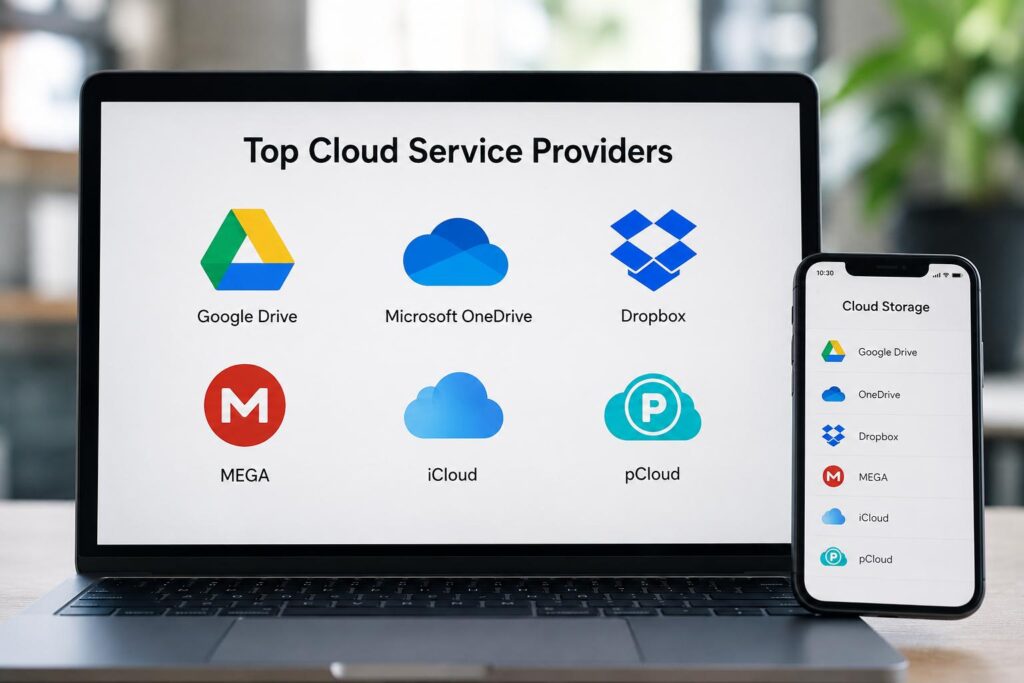
In today’s digital world, cloud storage services have become essential for both personal and professional use. Over the years, many companies have introduced powerful cloud platforms, each offering unique features such as free storage space, advanced encryption, fast synchronization, and seamless integration with other digital tools. Below are some of the most popular and reliable cloud storage providers used by millions of people around the world.
Google Drive
Google Drive was launched by Google in 2012 and quickly became one of the most widely used cloud storage platforms worldwide. It was designed for the purpose of providing users with a simple way to store files online, synchronize data across devices, and collaborate in real time. Before the introduction of Google Drive, Google primarily offered separate services like Google Docs. Google Drive unified cloud storage and productivity tools into a single ecosystem.
One of its major strengths is its deep integration with services such as Google Docs, Google Sheets, Google Slides, and Gmail. This integration makes it particularly useful for students, businesses, and remote teams. Google Drive enables users to securely store documents, photos, videos, and other digital files in the cloud, allowing access from smartphones, tablets, or computers anywhere with an internet connection.
Over the years, the platform has evolved to include advanced sharing controls, AI-powered search capabilities, offline access, and robust security features, including encryption and two-factor authentication. Today, Google Drive is considered one of the leading cloud storage services globally, serving hundreds of millions of users and playing a significant role in modern digital collaboration and online productivity.
MediaFire
MediaFire emerged as an early pioneer in online file hosting and cloud storage services when it was established in 2006. At a time when sharing large files over the internet was often slow and complicated, MediaFire introduced a user-friendly platform that simplified the processes of uploading, storing, and sharing files for everyday users. Its clean interface and straightforward download system quickly gained popularity among students, professionals, content creators, and online communities.
Over the years, MediaFire evolved from a basic file-sharing website into a more comprehensive cloud storage service. It introduced features such as folder organization, mobile access, synchronization across devices, and collaborative sharing. One of the platform’s greatest strengths has always been its simplicity, allowing users to share files via direct links without complicated setup.
MediaFire also gained a reputation for offering generous free storage compared to many competitors, making it an attractive choice for users seeking affordable online storage solutions. Today, despite facing strong competition from larger cloud platforms, MediaFire maintains a loyal global user base by focusing on convenience, accessibility, and fast file sharing for both personal and professional use.
Sync.com
Sync.com was founded in 2011 in Canada. Sync.com was created with a strong emphasis on privacy, security, and user control over personal data. Unlike many cloud storage providers that prioritize broad ecosystems and integrations, Sync.com built its reputation around end-to-end encryption, ensuring that files remain private and accessible only to the user. This privacy-focused approach quickly attracted individuals, businesses, and professionals who needed secure cloud storage for sensitive information.
Over the years, the platform has evolved from a small secure storage service into a trusted cloud solution that offers file synchronization, backup services, team collaboration tools, and secure file sharing across multiple devices. One of its most notable features is “zero-knowledge encryption,” which ensures that even the company itself cannot access users’ stored files or passwords.
Sync.com also includes advanced security features such as remote device wipe, password-protected sharing links, and compliance with strict privacy regulations. As concerns about digital surveillance and online data protection continue to grow worldwide, Sync.com has established itself as one of the leading privacy-focused cloud storage services, particularly for users who prioritize confidentiality and strong encryption above all else.
MEGA
MEGA was launched in 2013 and quickly gained global attention due to its strong emphasis on privacy, encryption, and generous free cloud storage. It was introduced as a successor to the earlier file-hosting service Megaupload and aimed to give users more control over their digital data, especially amid growing concerns about online security and surveillance.
MEGA distinguished itself by offering end-to-end encryption since its inception. This means that files are encrypted on the user’s device before they are uploaded to the cloud, making them inaccessible to intruders. The provision of a comparatively large amount of free storage space at that time was one of the key factors behind its rapid popularity.
MEGA has evolved beyond simple file hosting into a comprehensive cloud ecosystem over the years, which includes secure file sharing, encrypted messaging, backup solutions, and cross-platform synchronization for desktops and mobile devices. Its modern interface, privacy-first philosophy, and robust security framework have made it particularly appealing to users who prioritize data protection and confidential online storage.
MEGA is recognized as one of the leading cloud storage platforms in the world today. It offers a balance of accessibility, substantial storage capacity, and advanced encryption technologies for millions of users across the globe.
Dropbox
Dropbox was established in 2007 and became one of the first cloud storage platforms to revolutionize the way people store, synchronize, and share files online. It was created to address the common challenge of transferring files between devices. Dropbox introduced a simple yet groundbreaking system that automatically synced files across computers, smartphones, and tablets. Its user-friendly interface, clean design, and reliable synchronization technology quickly earned it immense popularity among students, professionals, and businesses worldwide.
With the passage of time, Dropbox evolved beyond basic file storage by adding powerful collaboration tools that enable teams to work together efficiently in real time. Features such as shared folders, file version history, cloud backup, document commenting, and integration with productivity applications made it particularly valuable in business settings and for remote work. The company also invested significantly in security by offering encrypted storage, multi-factor authentication, and advanced administrative controls for organizations.
Dropbox solidified its position as one of the leading cloud-based productivity platforms in the era where remote collaboration and digital teamwork have become increasingly essential.
Dropbox continues to serve millions of users globally today, particularly businesses and creative professionals who depend on seamless collaboration, secure file sharing, and efficient workflow management.
pCloud
pCloud entered the cloud storage industry in 2013 to provide secure, flexible, and long-term digital storage solutions for users around the world. pCloud became well-known for introducing lifetime storage plans, which allow users to make a one-time payment for permanent access to cloud storage. This unique approach quickly attracted both individuals and businesses seeking cost-effective alternatives to recurring subscription models.
Over the years, pCloud has expanded its platform with advanced features such as automatic file synchronization, cross-device access, media streaming, encrypted backups, and secure file sharing. One of its strongest selling points is pCloud Encryption, a security feature that provides client-side encryption to protect sensitive files from unauthorized access.
The service also supports seamless integration across Windows, macOS, Linux, Android, and iOS devices, making it highly convenient for users working across multiple platforms. With its combination of strong security, a modern interface, reliable performance, and innovative lifetime plans, pCloud has grown into one of the most respected cloud storage providers in the digital world, particularly among users seeking both affordability and advanced storage features.
Microsoft OneDrive
Microsoft OneDrive was originally introduced by Microsoft in 2007 under the name SkyDrive. It was developed to provide users with seamless cloud storage and synchronization across the Microsoft ecosystem. Microsoft gradually transformed the service into a fully integrated cloud platform closely connected with Windows and Microsoft Office applications as the internet-based computing and digital collaboration became more significant.
The service was officially renamed OneDrive in 2014 and continued expanding with improved storage options, stronger security features, and deeper integration into modern operating systems. OneDrive became especially popular among students, businesses, and office users because of its direct compatibility with tools such as Microsoft Word, Microsoft Excel, and Microsoft PowerPoint, allowing users to create, edit, and share files directly from the cloud.
Microsoft, over the years, added features such as automatic photo backup, real-time collaboration, file version history, ransomware protection, and advanced synchronization across multiple devices. Since OneDrive is built directly into Windows, it offers a smooth and convenient experience for millions of users worldwide.
Today, Microsoft OneDrive stands as one of the leading cloud storage platforms, widely recognized for its productivity-focused ecosystem, strong business integration, and reliable cloud-based file management solutions.
iCloud
iCloud was introduced by Apple in 2011 to provide a seamless cloud experience across its devices, including the iPhone, iPad, Mac, and Apple Watch. It replaced Apple’s earlier online service, MobileMe, and offered a more integrated system for storing photos, documents, contacts, messages, and backups in the cloud. One of iCloud’s most significant strengths is its deep integration within the Apple ecosystem, enabling users to automatically synchronize their data across devices without complicated setup processes.
Over the years, Apple has continuously expanded iCloud’s features to include iCloud Drive for file storage, automatic photo backup with iCloud Photos, device backup and restoration, Find My Device services, family sharing, and secure password management through iCloud Keychain. The platform has also introduced advanced privacy protections and encryption technologies to enhance user security and safeguard personal information.
Due to its smooth integration with Apple hardware and software, iCloud has become especially popular among users who rely heavily on multiple Apple devices in their daily lives. Today, iCloud remains one of the most widely used cloud services globally, serving as the foundation of Apple’s connected digital ecosystem. It offers millions of users convenient synchronization, secure storage, and effortless access to their data across all Apple platforms.
Amazon Drive
Amazon Drive was launched by Amazon in 2011. It was introduced as a cloud storage service that allows users to securely store photos, videos, documents, and other digital files online. This platform aimed to provide convenient cloud-based storage that integrated seamlessly with Amazon services and devices. Initially focused mainly on photo storage and backup, Amazon Drive gradually expanded its capabilities to include file synchronization, sharing options, and cross-device accessibility through web and mobile applications.
Despite facing fierce competition in the cloud storage market from strong rivals like Google Drive and Dropbox, Amazon Drive maintained its relevance through its simplicity, reliable infrastructure, and integration with Amazon’s broader cloud technologies. In recent years, Amazon has shifted its focus more toward its advanced cloud computing platform, Amazon Web Services (AWS), while transitioning consumer storage services to newer solutions like Amazon Photos.
Nevertheless, Amazon Drive played an important role in raising consumer awareness of cloud storage and enhancing Amazon’s presence in the digital data management landscape.
Conclusion
Cloud computing has fundamentally changed the way people interact with technology, impacting everything from personal data storage to large-scale business operations. What once required expensive hardware, physical servers, and complex software installations can now be accessed instantly via the internet from nearly anywhere in the world. Today, the cloud supports communication platforms, online education, digital entertainment, artificial intelligence systems, remote work environments, and countless everyday applications that millions of people rely on without even realizing it.
Its ability to provide flexibility, efficiency, scalability, and real-time accessibility has made cloud computing one of the most significant technological advancements of our time. As businesses continue to transition toward digital infrastructures and individuals become more connected through smart devices and online services, cloud computing will remain at the forefront of global technological progress.
In the future, advancements in artificial intelligence, cybersecurity, automation, and data processing are expected to enhance cloud technologies, making them even more powerful, intelligent, and intricately woven into daily life. This ensures that the cloud will continue to shape the future of the digital world for years to come.
Frequently Asked Questions
What is cloud computing in simple words?
Cloud computing is the delivery of computing services such as storage, software, and data processing over the internet instead of using only a personal computer or local device. It allows users to access files, applications, and services from anywhere with an internet connection.
Why is it called “the cloud”?
The term “cloud” comes from old computer network diagrams where the internet was represented as a cloud-shaped symbol. Today, it refers to remote servers and online systems that store and process data for users.
What are the main types of cloud computing?
The three main types of cloud computing are:
- Infrastructure as a Service (IaaS)
- Platform as a Service (PaaS)
- Software as a Service (SaaS)
Each type serves different purposes depending on the user and business needs.
Is cloud computing safe?
Cloud computing is generally safe because most providers use encryption, security monitoring, and advanced protection systems. However, users should still follow good security practices such as using strong passwords and enabling two-factor authentication.
What are the advantages of cloud computing?
Some major advantages include:
- Access files from anywhere
- Lower hardware costs
- Automatic backups
- Easy collaboration
- Flexible storage and scalability
These benefits make cloud computing useful for both individuals and businesses.
What are examples of cloud computing services?
Popular examples include:
- Google Drive
- Dropbox
- Microsoft OneDrive
- iCloud
These platforms allow users to store and access files online.
Do I need the internet to use cloud services?
Yes, most cloud services require an internet connection to access data and applications. However, some platforms offer offline modes that synchronize changes once the device reconnects to the internet.
What is cloud storage?
Cloud storage is a service that allows users to save files online instead of storing them only on physical devices such as hard drives or USBs. It provides easy access, backup, and file sharing capabilities.
Which cloud storage service is best?
The best cloud storage provider depends on your needs:
- Google Drive for productivity and collaboration
- Sync.com for privacy and encryption
- Dropbox for teamwork and business use
- iCloud for Apple device users
What is the future of cloud computing?
The future of cloud computing is expected to include stronger artificial intelligence integration, faster processing, improved cybersecurity, smarter automation, and more advanced digital services that will continue transforming businesses and everyday life.