The universe is vast, mysterious, and incredibly beautiful. One of the most significant facts about the universe is that it stretches far beyond human imagination, filled with galaxies, stars, planets, dark matter, cosmic forces, and astonishing phenomena that continue to surprise scientists. Even after centuries of research, we have only explored a tiny fraction of the cosmos, yet every discovery transforms our understanding of life, space, and reality itself.
29 mind-blowing facts about the universe will spark your curiosity, ignite your imagination, and remind you how extraordinary our cosmic home truly is. These facts are backed by modern science, astronomy, and astrophysics, yet they read like science fiction.
It is a journey into the infinite.
1. The universe is so big that light cannot reach us from most of it
In the night sky, we see stars shining across enormous distances. However, the shocking truth is that we can never see most of the universe. Not because our telescopes aren’t powerful enough, but because the universe is expanding faster than the speed of light. It is mind-boggling.
Why is this mind-blowing?
Because
- There are trillions of galaxies that are already beyond our “cosmic horizon.”
- Their light will never reach Earth, even if we wait for eternity.
- We live in a “visible bubble” called the observable universe.
- Beyond this bubble lies an ocean of space and galaxies forever unreachable.
The observable universe alone is about 93 billion light-years across, but the actual universe may be infinite.
This means you could point a telescope at the sky your entire life and still miss almost everything that exists.
2. There are more stars in the universe than grains of sand on Earth
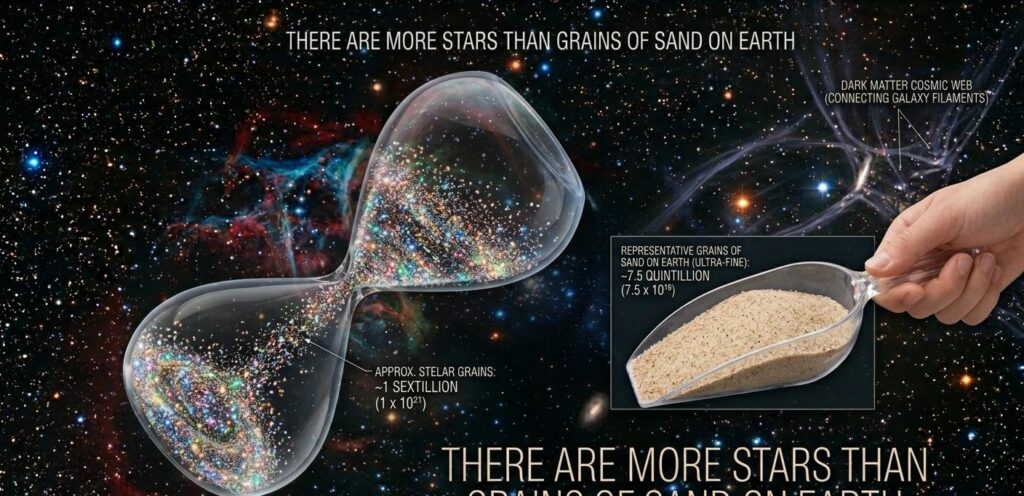
This is unimaginable. You may have heard this before, but let’s break it down with real math.
Number of stars in the universe
- The Milky Way alone has 100 to 400 billion stars.
- The observable universe contains at least 2 trillion galaxies.
- Multiply them, and you get:
200,000,000,000,000,000,000,000 stars (2 × 10²³)
Now compare that to the Earth.
Number of sand grains on all beaches
- Approximately 7.5 × 10¹⁸ grains.
This means that the universe has about 25,000 times more stars than Earth has grains of sand.
Imagine filling every beach, every desert, and every dune with stars, and that’s still not enough.
3. There are probably more planets than stars, and many may be Earth-like
For decades, scientists believed planets were rare. But modern telescopes, especially NASA’s Kepler and TESS missions, revealed something astonishing.
Planets are extremely common.
Most stars have planets orbiting them, and many have entire solar systems like ours.
Here’s the mind-blowing part.
Astronomers now estimate that there are at least 100 billion planets in our galaxy alone.
And since the universe contains about 2 trillion galaxies, the total number of planets is roughly
200,000,000,000,000,000,000,000 planets (2 × 10²³)
That’s more planets than
- stars
- grains of sand on Earth
- or even insects on Earth
And there is even more shocking news that many planets may be habitable
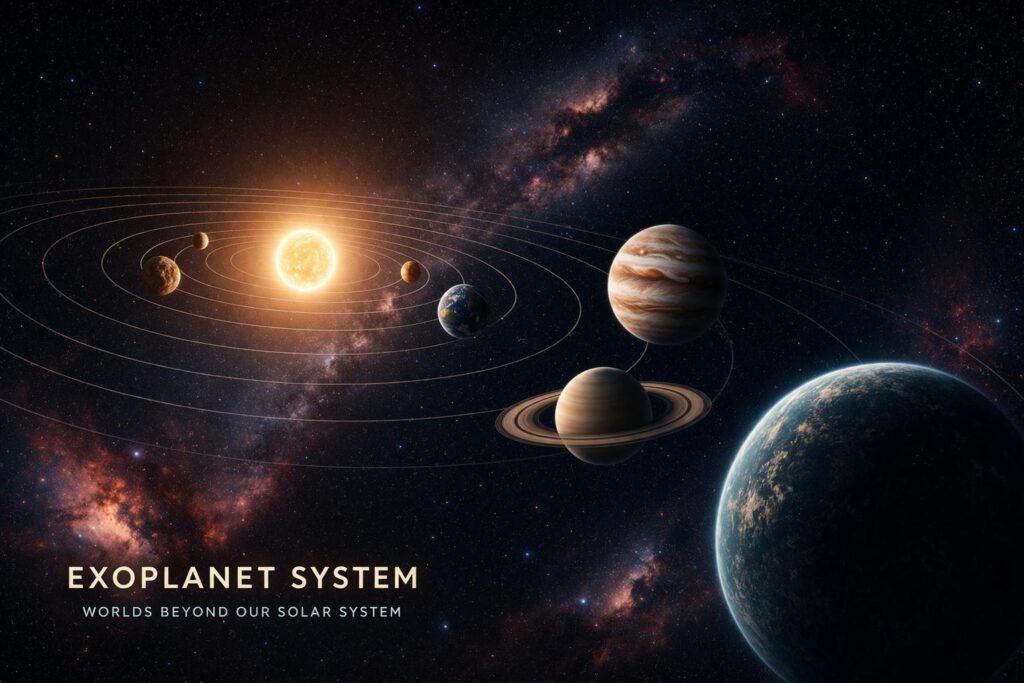
NASA has already discovered thousands of potentially Earth-like planets, including:
- Kepler-186f
- Proxima b
- Kepler-452b (Super Earth)
- TRAPPIST-1e, f, g
These planets
- are rocky
- have temperatures similar to Earth
- are located in the “habitable zone” where liquid water could exist
Scientists now believe there may be 40 billion Earth-like planets just in our one galaxy, the Milky Way.
This suggests that
- Earth is not unique
- life may exist elsewhere
- intelligent civilizations may be far more common than we imagine
- the universe may be teeming with life
We are not just one world in the universe.
We might be one of billions of potentially habitable worlds.
4. Space is completely silent, as sound cannot travel there
In movies, you hear explosions, rumbling spacecraft, and laser blasts in outer space.
But in reality?
Space is 100% silent.
Sound requires a medium like air, water, or solid objects to travel. In space,
- there is no air.
- no molecules to vibrate.
- no medium for sound waves.
So,
- a star could explode.
- a spaceship could crash.
- two asteroids could collide.
And you wouldn’t hear a single sound.
Astronauts communicate using radio waves, not sound waves. If you took your helmet off in space (don’t do that!), you wouldn’t even hear your own scream.
5. A Neutron Star is so dense that a teaspoon of it weighs a billion tons
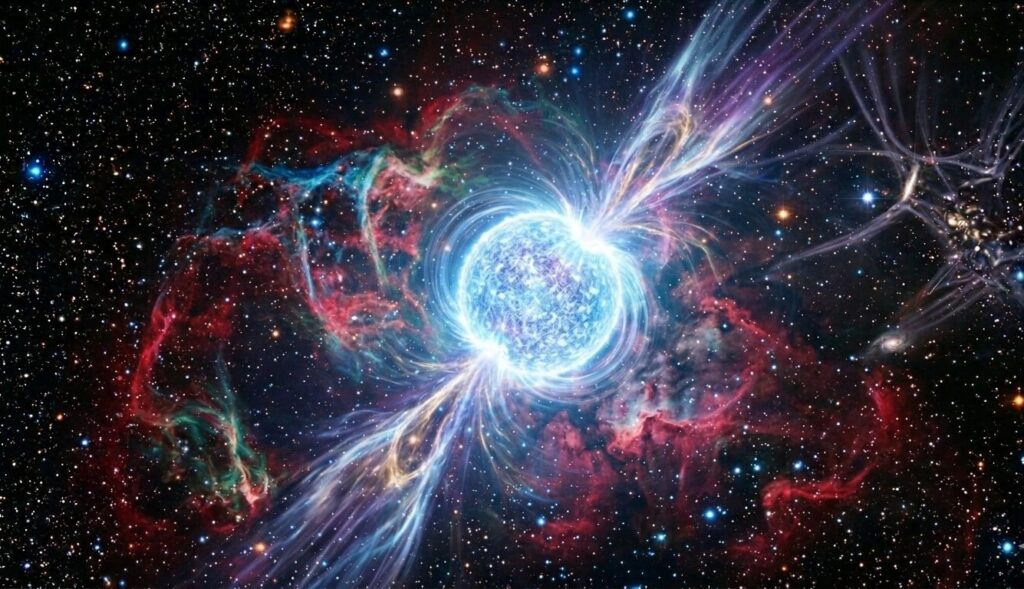
After a massive star explodes in a supernova, it sometimes collapses into a neutron star, one of the densest objects in the universe.
These stars compress unimaginable amounts of mass into a tiny space.
Density Comparison
- 1 teaspoon of neutron star material
= 1,000,000,000 (1 billion) tons
= Weight of all humans on Earth combined, times 10
= Equivalent of a mountain compressed into a sugar cube
Why is it possible
Gravity is so strong that
- electrons and protons fuse
- forming pure neutrons
- creating material so dense that atoms are squeezed to their breaking point
It’s one of the strangest, most extreme objects in the universe.
6. There is a massive “Cosmic Web” structure connecting galaxies
Most people imagine space as empty. But the universe is structured like a gigantic 3D web, called the Cosmic Web.
This web is made of
- dark matter
- gas filaments
- galaxy clusters
Why is this mind-blowing?
This is mind-blowing because
- galaxies are not floating randomly.
- they align along filaments, like beads on strings.
- these strings stretch for hundreds of millions of light-years.
- at the intersections are superclusters, the largest known structures.
The cosmic web looks like
- a neural network
- a spiderweb
- a living organism
In fact, the structure of the universe resembles the structure of the human brain.
7. Black holes can pause time and warp reality
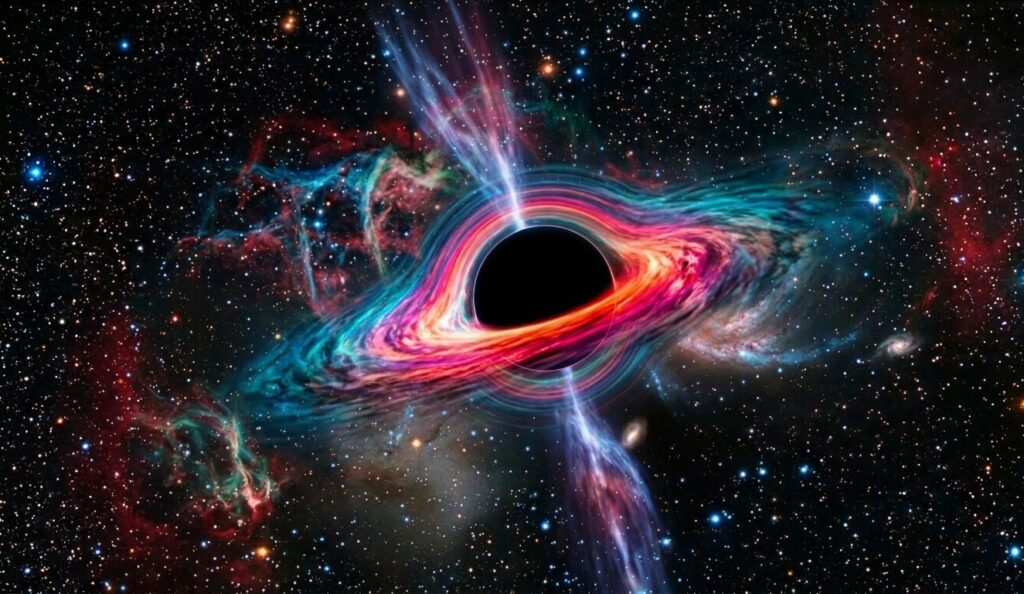
Black holes are the universe’s most extreme objects. Their gravity is so intense that they
- bend light
- warp time
- stretch space
- trap everything that crosses their event horizon
The most shocking fact
Time slows down around a black hole.
If you orbit a black hole for a few hours and return to Earth
- you may age 2 hours
- while Earth ages 10 years
This is called time dilation, predicted by Einstein’s theory of relativity.
Near the event horizon,
- time practically freezes
- space curves infinitely
- even light cannot escape
Black holes are not “holes” at all. They are collapsed stars that warp spacetime itself.
8. The universe is mostly invisible (Dark Matter + Dark Energy)
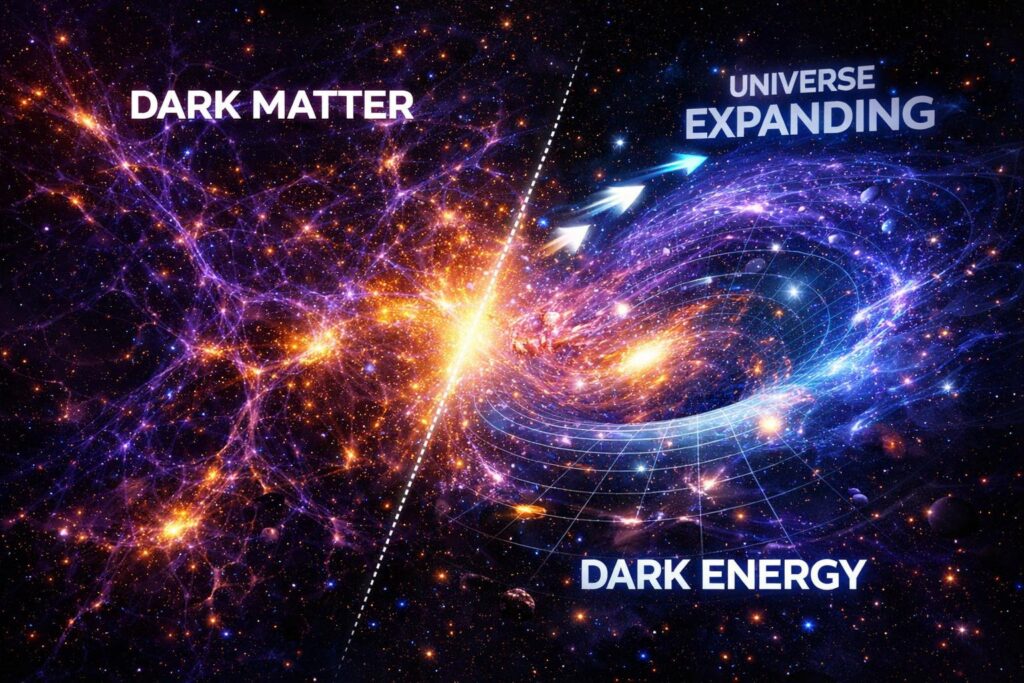
Everything you see, stars, planets, galaxies, makes up only 5% of the universe.
The rest
27% is Dark Matter
- Invisible
- Cannot be touched
- Passes through our bodies
- Holds galaxies together
- Creates gravity we cannot explain
And 68% is Dark Energy
- Even more mysterious
- Drives the expansion of the universe
- Accelerates cosmic growth
- Opposes gravity
Together, dark matter + dark energy make up 95% of reality, yet we cannot see or interact with them.
We live in a universe dominated by the unseen.
9. Some stars are so big that they could fit our solar system inside them
You think the Sun is large? It’s actually small compared to many stars.
Example: UY Scuti
- Diameter: 1,700 times larger than the Sun
- If placed in our solar system:
> It would extend beyond Jupiter
> Possibly even Saturn
Example: Betelgeuse
- 700 times bigger than the Sun
- Visible to the naked eye
- Currently nearing supernova stage
Example: Stephenson 2-18
- One of the largest stars ever discovered
- So large that 10 billion Suns could be inside it.
These stars challenge our sense of scale, making Earth look like a tiny grain of dust.
10. The universe has no center and no edge
Most people imagine the universe as a big expanding ball.
But scientifically, the universe is centerless.
Every point in space is expanding away from every other point. Imagine that
- raisins in a baking loaf of bread
- as the bread rises, every raisin moves away from all others
That’s the universe.
Does the universe have an edge?
Shockingly, the universe has
- no edge
- no center
- no “outside”
The universe is either
- infinite
or - finite but unbounded (like the surface of a balloon, no edges)
This fact alone can completely shift your understanding of reality.
11. The universe is still growing, and it’s growing faster every minute
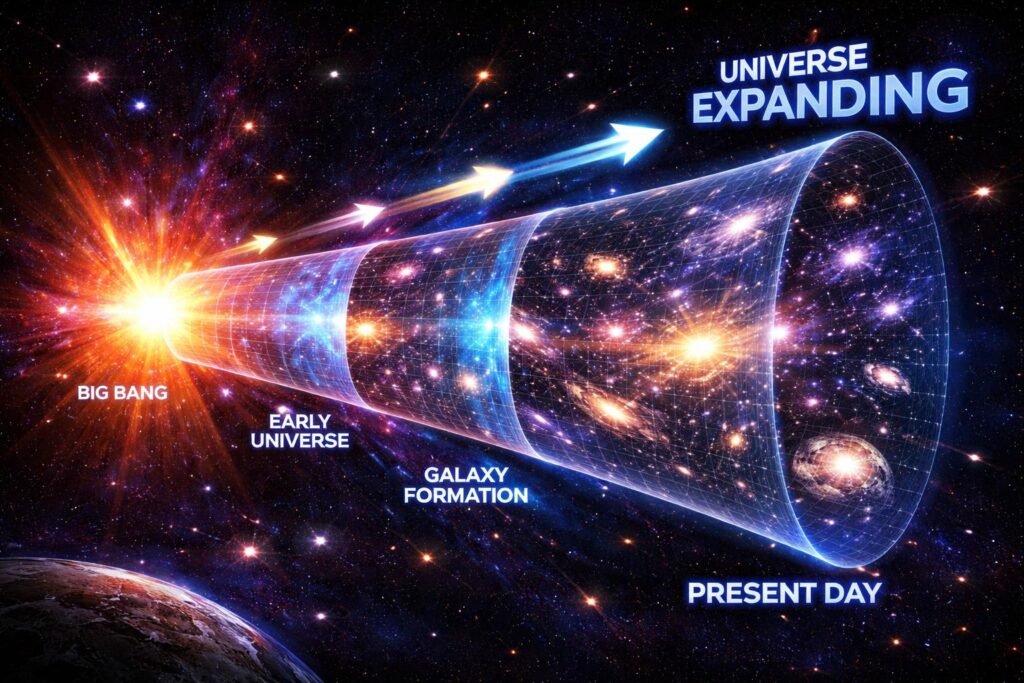
The universe began 13.8 billion years ago with the Big Bang. But it didn’t just explode. It has been expanding ever since. Even strangely,
- the expansion is accelerating
- galaxies are moving away faster
- space is stretching
This is due to dark energy, which behaves like an anti-gravity force.
This means that
- in the far future, galaxies will drift apart so much that the night sky will become empty.
- future civilizations (if they exist) may not see any galaxies beyond their own.
- they might never discover the true nature of the universe.
We live at a very special time, when the cosmos is still visible.
12. The universe might be one of many
Some physicists believe our universe isn’t the only one. Instead, it may be part of an enormous multiverse, a massive collection of universes, each with its own
- laws of physics
- types of matter
- number of dimensions
- timelines
- reality structures
This idea comes from
- Quantum mechanics
- String theory
- Cosmic inflation models
If the multiverse is real, then
- there may be infinite versions of reality
- other universes may contain alien life
- the laws of nature we know may be unique only to our universe
It’s one of the most exciting and mind-bending ideas in modern physics.
13. The universe might be a Hologram
No, not like a sci-fi movie, this is a real scientific hypothesis.
The Holographic Principle suggests that the 3D universe we live in may actually be encoded on a 2D surface at the edge of the cosmos.
In other words:
Our reality may be a projection.
A 3D illusion generated from 2D information.
This bizarre concept comes from research into the following:
- Black holes
- Quantum theory
- Information physics
Even top scientists like Stephen Hawking and Leonard Susskind took this idea seriously.
If true, everything we see, including ourselves, may be part of a cosmic hologram.
14. There are invisible “Rogue Planets” drifting through space
Not all planets orbit stars.
Some planets form normally, but later get kicked out of their solar systems by gravity. These are called rogue planets, and they drift alone through the darkness of space without any destination.
The estimated number in our galaxy is
Over 1 trillion rogue planets
Some are as big as Jupiter.
Some are frozen and dead.
Some might even have underground oceans heated by internal radiation.
These lonely worlds wander the galaxy like cosmic ghosts, silent, dark, and nearly impossible to detect.
15. The coldest known place in the universe is colder than empty space
The Boomerang Nebula holds a strange record as the coldest place in the known universe.
Temperature is –272°C (1 degree above absolute zero)
This makes it
- the coldest natural place ever found
- even colder than the cosmic background temperature
Nothing in the universe can be colder than –273.15°C, except artificially in labs.
The Boomerang Nebula comes terrifyingly close.
16. Galaxies can collide, and ours will too
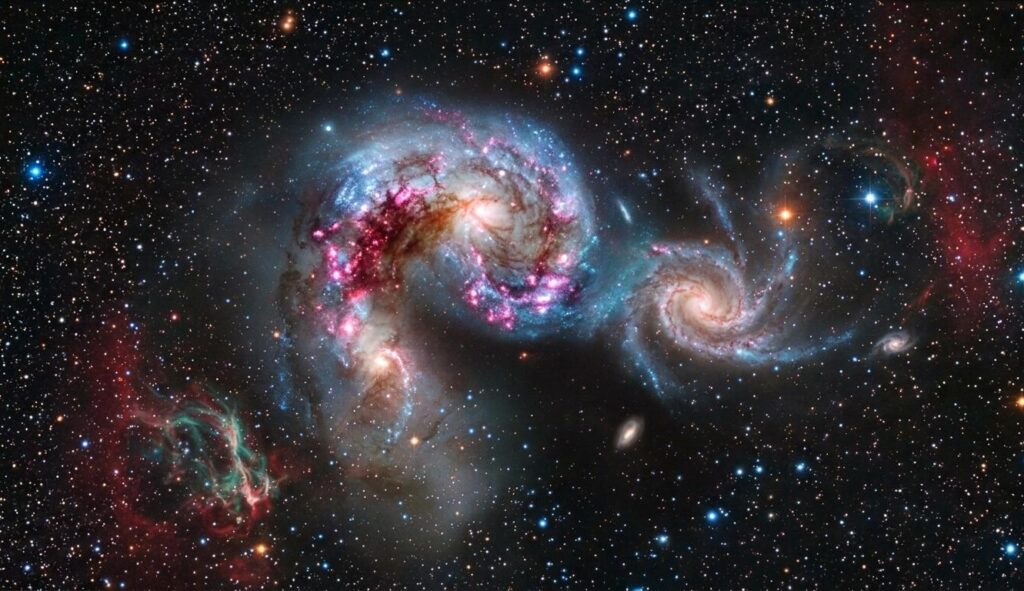
Galaxies aren’t stationary. They move through space at incredible speeds as the universe is expanding.
The Milky Way is currently on a collision course with the Andromeda Galaxy.
Collision expected in 4.5 billion years
The new galaxy will be called Milkdromeda or Milkomeda
Despite this, stars likely won’t crash into each other. There’s too much empty space.
But the night sky will change dramatically.
If humans survive that long, the view will be breathtaking.
17. Stars can turn into Diamond Cores
Did you know there are diamond stars in space?
When a white dwarf cools down over billions of years, its carbon core can crystallize into
A diamond the size of Earth.
One famous example:
- Lucy (BPM 37093), a 10 billion trillion-carat diamond star
- Located 50 light-years away
The Beatles’ song Lucy in the Sky with Diamonds inspired its nickname.
Space is full of surprises, and some of them literally shine.
18. You are made of stardust
Every element in your body, like carbon, oxygen, calcium, and iron, was forged in the core of a star.
When giant stars explode in supernovae, they scatter their elements across the galaxy. Eventually, these materials form new stars, planets, and life.
You are literally made from ancient star debris.
Every atom in your body is billions of years old.
Carl Sagan said it beautifully:
We are made of starstuff.
19. There is a giant cloud in space that smells like rum and contains sugar
Yes, this is real.
Astronomers discovered a huge molecular cloud near the center of the Milky Way filled with:
- Ethyl formate (gives rum its flavor)
- Glycolaldehyde (a simple sugar)
- Other organic molecules
This suggests the building blocks of life are common in space.
The cloud is called Sagittarius B2, and it is a trillion kilometers wide.
Space doesn’t just create stars. It creates ingredients for life.
20. The universe might be infinite in time as well as space
We know the universe is around 13.8 billion years old, but what if this version of the universe isn’t the first?
Some theories suggest:
- The universe goes through cycles of Big Bangs and Big Crunches
- Our “Big Bang” may not be the beginning
- Multiple universes may have existed before ours
- Time may have no beginning or end
This idea turns everything we know upside down and opens the door to unimaginable cosmic histories.
21. The largest known structure in the universe is bigger than the laws of Physics allow
Astronomers discovered the Hercules, Corona Borealis Great Wall, a massive galactic structure stretching 10 billion light-years across.
But here’s the crazy part:
The laws of cosmology say no structure larger than 1.2 billion light-years should exist.
Yet this “Great Wall” is 8 x bigger than what should be physically possible.
Scientists still can’t explain it.
22. There is a massive void in space where almost nothing exists
The Bootes Void, also called “The Great Nothing,” is an enormous empty region in space about 330 million light-years wide.
Nothing exists inside this void:
- No stars
- No galaxies
- No visible matter
It is one of the largest known empty spaces in the universe, like a cosmic desert so vast that if the Milky Way were inside it, humans would never detect other galaxies.
23. Some stars are older than the universe itself, apparently
The star HD 140283, nicknamed the Methuselah Star, appears to be 14.5 billion years old.
The problem is the known age of the universe.
The universe is 13.8 billion years old.
This paradox led scientists to revise measurement techniques several times, yet the age still appears older. It remains an open mystery.
24. Some Quasars shine brighter than 600 trillion suns
Quasars are supermassive black holes that blast energy into space.
Some quasars are
- 600 trillion times brighter than our Sun
- Visible from 13 billion light-years away
- Powered by black holes with billions of solar masses
One quasar, ULAS J1120+0641, is so bright that scientists say it defies known models of early-universe formation.
25. A strange “Great Attractor” is pulling our entire galaxy toward it
The Milky Way, Andromeda, and thousands of nearby galaxies are rushing toward an unknown gravitational anomaly called the Great Attractor at the
speed of 600 km/s
Location is behind dense dust clouds, largely invisible
Cause is unknown
Some theories suggest it is
- a massive cluster of galaxies
- a supervoid
- a new kind of dark matter structure
Even today, it remains one of cosmology’s biggest mysteries.
26. The universe has “Cold Spots” that should not exist
The CMB Cold Spot, discovered in 2004, is an unusually cold region in the cosmic background radiation.
Explanation attempts include that there is
- a massive void
- a quantum fluctuation
- evidence of universes colliding
- a sign of the multiverse
However, no theory has fully explained it yet.
27. Time passes at different speeds in the universe
Einstein’s relativity shows that time is not constant. It stretches and compresses.
Examples:
- Time moves more slowly near massive objects
- On Earth’s surface, time moves more slowly than on mountaintops
- Astronauts age slightly slower in orbit
This means time itself is not universal. It is flexible.
28. Saturn’s moon Titan has lakes of liquid Methane
Titan is one of the few places in the solar system with surface liquids.
But the lakes aren’t water. They are
- Methane
- Ethane
It rains methane, has methane rivers, and even methane seas. Scientists say Titan could host exotic life that breathes methane instead of oxygen.
29. The universe is getting more invisible every day
Most of the universe is made of
- 68% dark energy
- 27% dark matter
- 5% normal matter (everything we see)
This means that
95% of the universe is invisible
we cannot directly see what the universe is mostly made of
all stars, planets, and galaxies make up almost nothing
Scientists admit they have no idea what dark matter or dark energy actually are. Humanity understands only a tiny fraction of reality.
The universe is a miracle beyond imagination
These 29 mind-blowing facts are only the beginning. The universe is filled with wonders we haven’t discovered yet, mysteries we cannot explain, and cosmic forces that defy logic.
Studying the universe reminds us that:
- We are part of something enormous
- Reality is far stranger than we think
- Every discovery opens new questions
- The cosmos is dynamic, evolving, and alive
Whether you love astronomy, philosophy, science, or spirituality, the universe is the ultimate source of inspiration.
And the more we learn, the more magical it becomes.
FAQ
1. Are there really more planets than stars in the universe?
Yes. Modern telescopes like NASA’s Kepler and TESS have revealed that planets are far more common than previously believed. Most stars have planets, and many have entire solar systems. Scientists estimate there could be over 200 sextillion planets in the observable universe, far more than the number of stars.
2. How many Earth-like planets exist in our galaxy?
Astronomers estimate there may be 40 billion Earth-like planets in the Milky Way alone. These planets exist in the “habitable zone” of their stars, meaning they might have temperatures that allow liquid water, a key ingredient for life.
3. Could life exist elsewhere in the universe?
Yes, it is very possible. With billions of potentially habitable planets, astronomers believe life may exist elsewhere, at least in microbial form. Systems like TRAPPIST-1, Kepler-452b, and Proxima b are promising candidates for hosting life.
4. What is the multiverse theory?
The multiverse theory suggests that our universe might be just one of many universes. These parallel universes may have different physical laws, dimensions, or timelines. While not yet proven, it is supported by quantum mechanics and cosmology models.
5. Is it true the universe might be a hologram?
Yes, some physicists propose the Holographic Principle, which suggests that our 3D universe is actually encoded on a 2D surface at the cosmic boundary. This means reality could be a projection, similar to a hologram. It is one of the most fascinating concepts in theoretical physics.
6. What are rogue planets?
Rogue planets are planets that drift through space without orbiting any star. They were likely ejected from their original solar systems. Scientists estimate there may be over 1 trillion rogue planets in the Milky Way. Many are dark, frozen, and extremely difficult to detect.
7. What is the coldest place in the universe?
The coldest known natural place in the universe is the Boomerang Nebula, with a temperature of just 1 Kelvin (–272°C). This makes it colder than the vacuum of space and nearly as cold as physics allows.
8. Will the Milky Way and Andromeda galaxies really collide?
Yes. The Milky Way and Andromeda are moving toward each other at 110 km/s and are expected to collide in about 4.5 billion years. The result will be a new super-galaxy nicknamed Milkdromeda. Despite the collision, stars are unlikely to crash due to the immense distances between them.
9. What is a diamond star?
A diamond star is a crystallized white dwarf with a carbon core that has solidified into a massive diamond structure. One famous example is BPM 37093, nicknamed “Lucy,” which contains a diamond weighing 10 billion trillion trillion carats.
10. Are humans really made of stardust?
Yes. Nearly every atom in your body, carbon, iron, oxygen, and calcium, was created inside ancient stars. These stars exploded as supernovae, scattering elements across the galaxy. Over billions of years, those materials formed new stars, planets, and eventually life. This is why scientists say, “We are made of stardust.”
11. Is there alcohol or sugar in space?
Surprisingly, yes. A massive cloud near the center of the Milky Way, called Sagittarius B2, contains ethyl formate (the chemical that gives rum its flavor) and simple sugars like glycolaldehyde. These organic molecules suggest that the ingredients for life exist naturally in the cosmos.
12. Is the universe infinite?
We don’t know for sure. Some theories suggest the universe could be infinite in size. Others suggest it is finite but unbounded, like the surface of a sphere. Some models even propose that our universe is just one “cycle” in a series of previous universes that existed before the Big Bang.
13. Could the universe have existed before the Big Bang?
Possibly. Certain cosmology models, like the cyclic universe theory, propose that the universe undergoes endless cycles of expansion and contraction. This means the Big Bang may not have been the ultimate beginning, but just the beginning of our current universe.
14. Are galaxies rare or common?
Galaxies are extremely common. The observable universe contains about 2 trillion galaxies, each with hundreds of billions of stars. Some galaxies are small and faint, while others, like IC 1101, are over 50 times larger than the Milky Way.
15. What is the most mysterious thing in the universe?
Dark energy is considered the most mysterious. It accounts for 68% of the universe and is accelerating the expansion. Scientists have no idea what it is made of or how it works.
16. What is the most powerful event in the universe?
Supernovae and gamma-ray bursts are among the most powerful events. A gamma-ray burst can release more energy in 10 seconds than our Sun will produce in its entire 10-billion-year lifetime.
17. What is a cosmic void, and why is it considered mind-blowing?
A cosmic void is an enormous region of space with almost no galaxies or stars. These voids can be hundreds of millions of light-years wide, making them some of the largest empty structures in the universe.
18. Do parallel universes really exist according to modern physics?
Many cosmologists believe parallel universes are possible due to theories like string theory, inflation, and the multiverse hypothesis. While unproven, these ideas suggest our universe may be just one of many.
19. What is the Bootes Void, and why is it called the “Great Nothing”?
The Bootes Void is a massive cosmic empty region around 330 million light-years wide. Its extreme lack of galaxies makes scientists call it the “Great Nothing.”
20. How do we know the universe is expanding faster over time?
Astronomers use Type Ia supernovae to measure cosmic distances. Observations show these galaxies are moving away faster than expected, proving that universal expansion is accelerating.
21. What is dark energy, and how does it affect the universe?
Dark energy is a mysterious force pushing galaxies apart. It makes up about 68% of the universe and is responsible for the accelerating expansion of space.
22. Is it true that some stars can explode multiple times?
Yes. A rare type of star called a pulsational pair-instability star can violently explode, collapse, and explode again before its final death.
23. What makes a magnetar different from a normal neutron star?
Magnetars have magnetic fields trillions of times stronger than Earth’s. Their magnetic power is so intense that it can distort atoms and generate bursts brighter than an entire galaxy.
24. Can galaxies really “eat” smaller galaxies?
Yes. Larger galaxies like the Milky Way grow by absorbing smaller ones in a process called galactic cannibalism. Evidence of past “meals” is visible in star streams around galaxies.
25. How do stellar black holes form?
Stellar black holes form when massive stars collapse under their own gravity after a supernova explosion, creating a region where not even light can escape.
26. Are supermassive black holes found in all galaxies?
Most large galaxies, including the Milky Way, have a supermassive black hole at their center. These giants can contain millions or even billions of solar masses.