
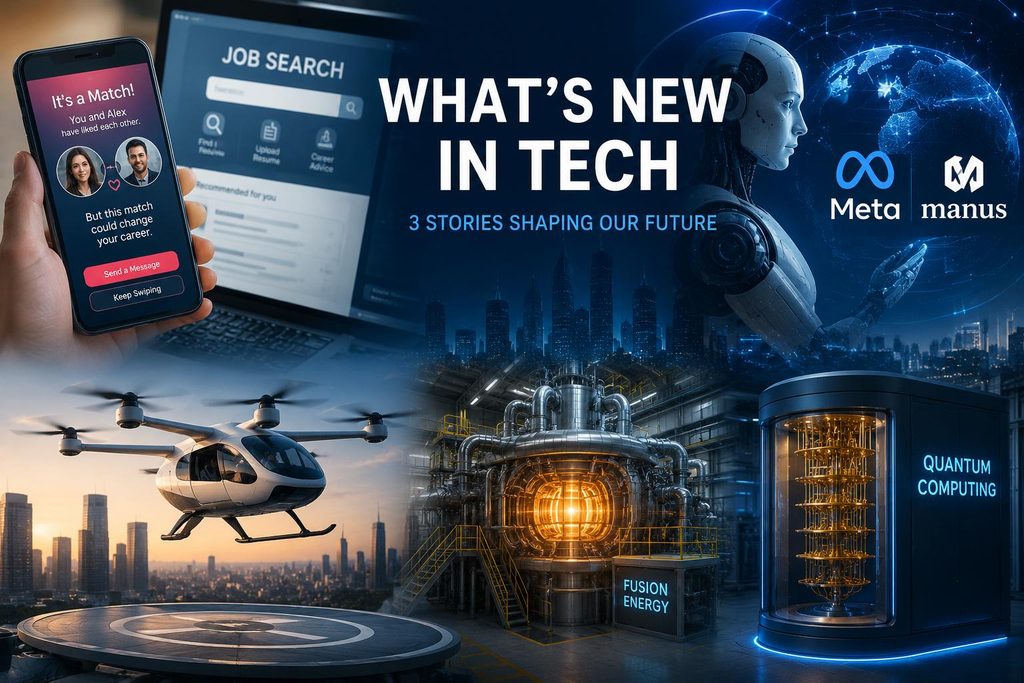
Technology is moving at extraordinary speed. From people using dating apps to find employment to billion-dollar battles over artificial intelligence, and from flying taxis to nuclear fusion and quantum computing, technologies that once seemed far away are increasingly becoming part of the real world.
Here are three fascinating technology developments worth knowing about.
1. Swipe Right to Find a Job
Could your next job interview begin with a dating-app match?
Some job seekers are increasingly turning to dating apps as an unconventional way to make professional connections. Bloomberg reported on this unusual trend, citing research from career platform ResumeBuilder.com. The research found that one in three dating-app users surveyed said they had used a dating app to seek employment opportunities, while two-thirds said they had targeted potential matches who worked for desirable employers.
The reasoning is surprisingly simple: a dating app can sometimes provide a direct route to a real person inside a company rather than sending another résumé into an enormous online recruitment system.
For some users, this has turned professional networking into an unusual form of digital matchmaking.

One Hinge user, Kait O’Neil, reportedly networked so extensively through the platform that she eventually felt uncomfortable matching with people solely because of their professions. She changed her profile to make it clear that she was using the app primarily to look for a job.
Is Dating-App Job Hunting the Future?
Probably not for everyone, but the trend highlights a larger change in the way people search for work.
Professional networking is increasingly happening across platforms that were never originally designed for recruitment. Social media, online communities, creator platforms, and even dating apps can provide access to people who may otherwise be difficult to reach.
The lesson for job seekers is not necessarily to turn every dating profile into a résumé. Instead, it shows the growing importance of personal networking and direct connections in an increasingly competitive employment market.
The traditional résumé is not disappearing, but the way people get their résumé in front of the right person is changing.
2. Meta’s AI Deal turns into a Technology and Geopolitical Battle
Artificial intelligence (AI) is no longer just a competition among companies. It has increasingly become a matter of national strategy.
One striking example is the complicated story surrounding Manus, an AI-agent startup founded by Chinese entrepreneurs Xiao Hong and Ji Yichao, along with co-founder Zhang Tao.
Manus attracted international attention after launching an AI agent capable of performing complex tasks with relatively little human intervention. The company later moved much of its operations to Singapore, and Meta announced a deal valued at more than $2 billion to acquire the startup, according to reporting by The Wall Street Journal and other technology publications.
But the deal soon became caught in the growing technological rivalry between China and the United States.
In April 2026, China’s National Development and Reform Commission blocked the acquisition and ordered the parties to unwind the transaction. Meta subsequently began separating its operations and data systems from Manus. TechCrunch reported that the Chinese government had intervened after months of regulatory scrutiny.
Why the Manus Story Matters
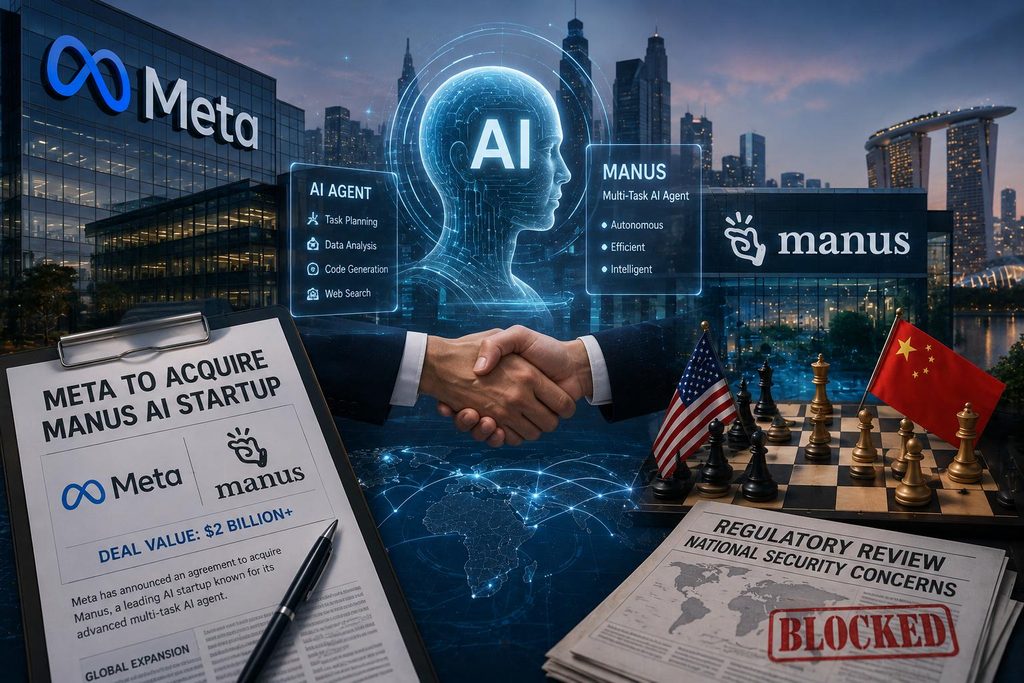
AI technology has become strategically important enough that governments are increasingly concerned about where advanced AI systems are developed, who controls them, where their data is stored, and where their engineers and intellectual property ultimately reside.
The Manus case demonstrates how difficult it can be for a technology company to separate itself completely from the country in which its technology and talent originated.
It also highlights the growing US-China competition over artificial intelligence.
For the technology industry, the message is clear: the future of AI will not be shaped only by algorithms, engineers and investors. Governments, national-security concerns, regulations and international politics are becoming part of the equation too.
3. Technologies Once Called “Futuristic” are Becoming Real
Flying cars, nuclear fusion and quantum computers have appeared in science-fiction stories for decades.
Now, some of these technologies are moving from laboratories and prototypes toward real-world applications.
Flying Taxis are Taking Off
Electric vertical takeoff and landing aircraft, commonly known as eVTOLs, are moving closer to commercial aviation.
China’s EHang has already achieved a significant milestone. In March 2025, two operators of its EH216-S pilotless passenger aircraft received Air Operator Certificates from China’s Civil Aviation Administration, allowing commercial passenger-carrying operations at designated sites.
According to EHang’s official announcement, these were the first Air Operator Certificates issued in China for operators of pilotless passenger-carrying eVTOL aircraft.
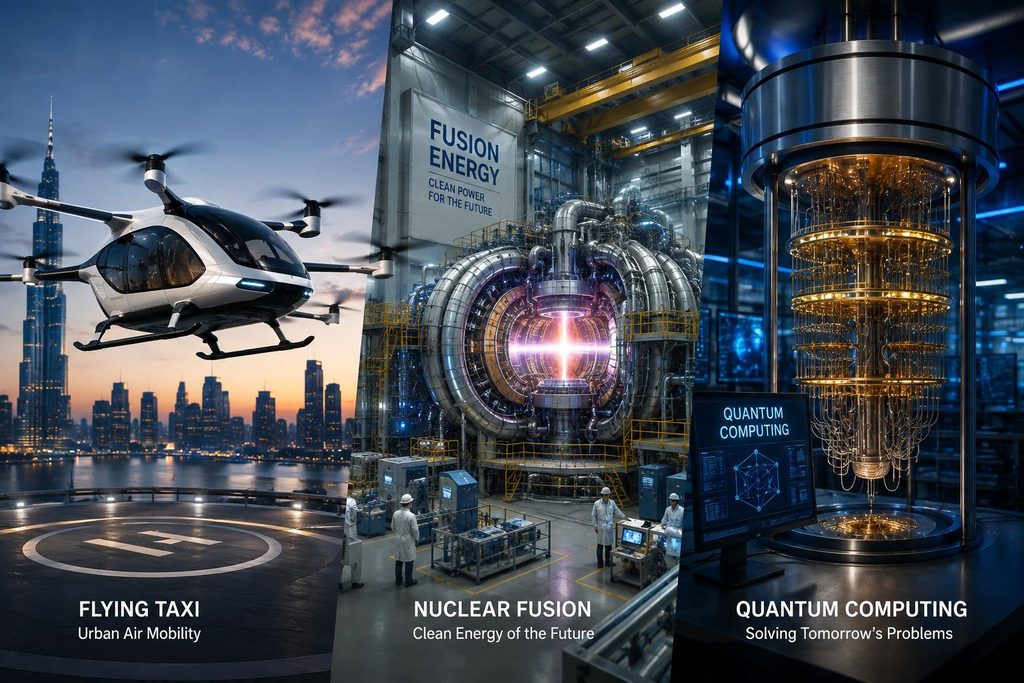
Meanwhile, U.S.-based Joby Aviation is working toward commercial air-taxi operations in Dubai and has said it expects to carry its first passengers there in 2026.
These aircraft are still far from replacing conventional cars or airplanes, but the technology is moving beyond the purely experimental stage.
Nuclear Fusion Moves Toward the Power Grid
Nuclear fusion has often been described as the ultimate clean-energy technology, but also as something perpetually decades away.
That may be changing.
Washington-based Helion Energy has begun construction of its Orion fusion power plant. The company has an agreement to supply electricity to Microsoft, with initial operations planned for 2028 and a target of at least 50 megawatts.
Helion announced that the project had received approvals for the next phase of construction and described Orion as its planned commercial fusion power plant.
Fusion works by combining light atomic nuclei under extreme conditions, releasing energy in the process. The challenge is making the reaction efficient, reliable, and economical enough for commercial electricity generation.
Helion’s project does not mean commercial fusion has been solved; the technology still faces enormous engineering and economic challenges, but the fact that a company is actually constructing a proposed commercial facility is significant.
Quantum Computing Enters the Commercial Era
Quantum computing is another field moving from theoretical research toward practical experimentation.
In November 2025, Quantinuum announced the commercial launch of Helios, a general-purpose quantum computer designed for enterprise use. The company made the system available through cloud and on-premises access and highlighted potential applications including drug discovery, materials science and financial analysis.
The machine uses qubits, the fundamental units of quantum information, rather than conventional binary bits.
Quantum computers are not simply faster versions of today’s computers. They use quantum-mechanical principles to approach certain problems in fundamentally different ways.
Quantum computing remains an emerging technology with significant limitations. But commercial access to increasingly capable systems suggests that the technology is progressing from laboratory research toward practical experimentation.
The Bigger Picture: The Future is Arriving in Pieces
These three stories may appear unrelated.
A person looking for a job on a dating app has little in common with an AI startup caught between international regulators, while flying taxis and quantum computers seem to belong to an entirely different world.
But together they reveal an important trend:
Technology is changing not only the devices we use, but also the way we work, communicate, compete, and solve problems.
AI is reshaping employment and becoming a strategic national technology. Autonomous aircraft are beginning to enter regulated commercial operations. Fusion companies are attempting to build power plants. Quantum computers are becoming accessible to businesses.
None of these technologies has completely transformed everyday life yet.
But they are moving.
And that may be the most important technology story of all.
The future is no longer simply something we are waiting for. In many areas, it is already being built.
Attribution & Further Reading
This article was researched and written for Study2Inspire using information reported by established news organizations and official company announcements.
- The employment/dating-app trend was reported by Bloomberg, drawing on research from ResumeBuilder.com.
- The Meta – Manus developments were reported by The Wall Street Journal and technology news outlets including TechCrunch.
- Information about EHang’s eVTOL operating certificates was based on EHang’s official announcement.
- Information about Joby’s Dubai operations was based on Joby Aviation’s public company disclosures.
- Information about Helion’s Orion fusion project was based on Helion Energy’s official announcements.
- Information about the Helios quantum computer was based on Quantinuum’s official announcement.
Study2Inspire does not claim these developments as original reporting. The purpose of this article is to explain and contextualize important technology developments for students, educators, and general readers.