
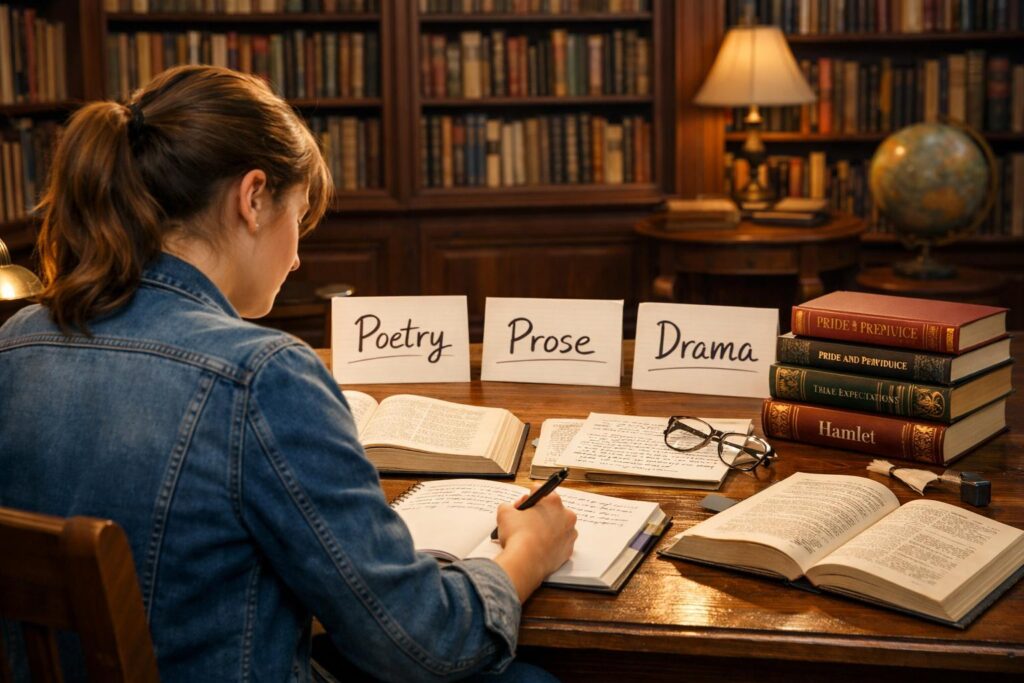
English literature is one of the most profound, prolific, and enriching fields of human study. English literature isn’t merely about reading books, dramas, poems, or plays, but it is about exploring the depth of human thoughts, emotions, imagination, culture, and human civilization through language. Literature works as a mirror of society. It reflects the beliefs, struggles, and aspirations of people across various periods. It paints the real picture of societies that lived in the past.
English literature, being adaptive, has evolved continuously with time, from ancient heroic tales to modern experimental narratives, adapting to social, political, and technological changes. It is one of the most realistic and reliable tools that provides readers with an opportunity to travel across time and space, and to develop a deeper awareness of human nature.
Literature is a gateway to intellectual development for students. For writers, it is a source of inspiration, and for readers, it is a companion offering comfort, wisdom, and insight. In this furious age of technology dominated by fast digital content, literature remains one of the most powerful forces encouraging slow, calm thinking, deep reflection, and meaningful comprehension.
We will explore English literature in detail. Its meaning, historical development, major genres, influential authors, and its enduring importance in the present world.
Click here to explore the best online courses for English Literature
What is English Literature?
English literature refers to the body of written works produced in the English language, such as poetry, prose, drama, novels, essays, and other forms of creative expression. However, defining literature simply as written text would be incomplete. Literature portrays the artistic expression of human experience in its essence.
Literature captures the complexities of life, love, loss, ambition, conflict, and identity through carefully crafted language by the men of litters. Literature is different than ordinary communication. It uses stylistic techniques such as imagery, symbolism, and metaphor to convey deeper meanings.
One of the defining features of literature is its ability to evoke emotions and provoke thoughts. A reader does not simply read literature. They feel and experience it. They connect with characters, reflect on themes, and often find parallels between the text and their own lives.
Moreover, English literature doesn’t mean work produced in England. It also includes writings by authors from around the world who live in other countries and use English to express their feelings and thoughts. Therefore, it is one of the most diverse languages, ever-expanding and enriched by different cultures and perspectives.
History of English Literature
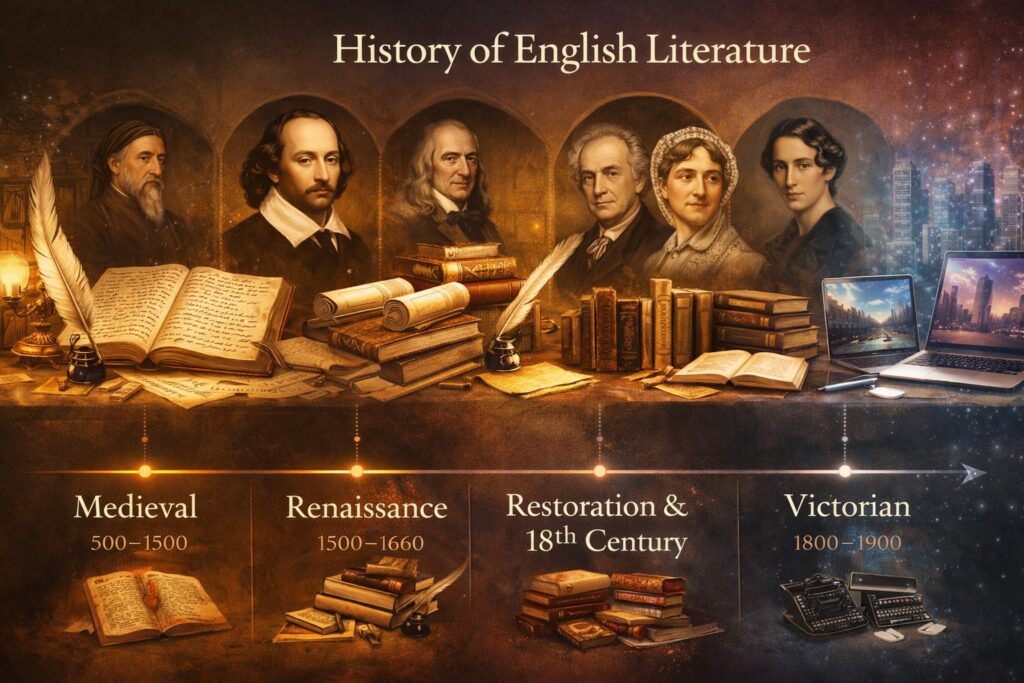
The history of English literature is vast and fascinating, spanning more than a thousand years. Each period reflects the social, political, and cultural environment of its time and people.
1. Old English period (450-1066)
The earliest stage of English literature is known as the Old English period. It was the period when people told stories primarily orally. In this era, literature was passed down through generations by word of mouth before being written down. The language of that period is very different from modern English and can be difficult to understand today.
Beowulf is one of the most famous works of this era. It is an epic poem that tells the story of a heroic warrior who fights battles with monsters and dragons, reflecting values of the time such as bravery, loyalty, and honor.
Literature of this period often focused on heroic deeds, religious themes, and the struggle between good and evil. The foundation for the development of English literary traditions was laid during this period.
2. Middle English period (1066-1500)
After the Norman Conquest of England in 1066, the Middle English period brought significant changes to the English language, incorporating many French and Latin influences.
Geoffrey Chaucer is one of the most important figures of this period. His work, The Canterbury Tales, is considered a masterpiece. This is an amazing collection of stories providing a vivid image of medieval society, showcasing different social classes, professions, and personalities.
English Literature of this period was more diverse, including religious writings, romances, and allegorical works. This era marked a transition from purely religious themes to more human-centered stories.
3. Renaissance period (1500-1660)
The Renaissance period is known as a period of cultural revival and intellectual growth. It emphasized humanism as it focused on human potential and achievements. Literature during this period became more sophisticated and expressive.
The genius of William Shakespeare dominates this era. His works have had a lasting impact on English literature. Plays such as Hamlet and Macbeth explore complex themes such as ambition, power, betrayal, and morality.
The Renaissance also saw the rise of poetry, essays, and drama as major literary forms. Writers experimented with language and style, creating works that continue to be studied and admired today.
4. Neoclassical period (1660-1798)
The Neoclassical period is the period of reason, logic, and order. Writers of the era followed classical principles derived from ancient Greek and Roman literature. Literature during this period often focused on satire, morality, and social commentary.
Literary works of the authors of this period criticized society and promoted rational thinking. This period cherished clarity, structure, and discipline in writing.
5. Romantic period (1798-1837)
The shift from reason to emotion and imagination is the essence of the Romantic period. Writers of the Romantic Period rejected the strict rules of the Neoclassical period and embraced creativity and individual expression.
Poets like William Wordsworth and Samuel Taylor Coleridge celebrated nature, beauty, and human emotions. Their works often reflect a deep connection with the natural world and a focus on personal experience.
Romantic literature inspires readers to appreciate the beauty of life and the power of imagination.
6. Victorian period (1837-1901)
The Victorian period saw industrial and social change. Literature of this era often addressed issues like poverty, inequality, and social justice.
Writers like Charles Dickens wrote novels to highlight the struggles of the poor and criticize societal problems. Their works are known for their rich characters and detailed storytelling.
Novel rose as a dominant literary form in the Victorian period, and made literature more accessible to the general public.
7. Modern and contemporary period (20th century-present)
Modern literature reflects the complexities of the modern world, its trends, traditions, culture, and civilization. It explores themes like identity, alienation, technology, and globalization.
Writers of this era experiment with new styles and techniques, breaking traditional rules. Literature of the modern period has become more diverse, representing different cultures and voices.
This is how literature continues to evolve, adapting to changing times while maintaining its core purpose of exploring human experience in the modern and contemporary period.
Major genres of English Literature

English literature is generally categorized into several major genres, each characterized by its own style, purpose, and artistic techniques. These genres provide various ways to express ideas, emotions, and experiences. Understanding these genres enhances readers’ appreciation of the richness and diversity of literature.
1. Poetry
Poetry is one of the oldest and most artistic forms of literature, deeply rooted in human expression. It employs rhythm, sound, imagery, and carefully chosen words to convey emotions and ideas powerfully and concisely. Unlike prose, poetry often follows structured patterns, such as meter and rhyme, although modern poetry may deviate from these conventions.
One of the defining features of poetry is its use of figurative language. Devices such as metaphors, similes, symbolism, and personification allow poets to express complex emotions in imaginative ways. For example, in “I Wandered Lonely as a Cloud”, William Wordsworth uses nature imagery to convey feelings of peace and joy. Similarly, John Keats, in “Ode to a Nightingale”, explores themes of beauty, mortality, and the passage of time through rich and sensory language.
Poetry can be categorized into different types:
- Lyric Poetry – Expresses personal emotions and thoughts (e.g., sonnets by William Shakespeare)
- Narrative Poetry – Tells a story in verse (e.g., The Rime of the Ancient Mariner by Samuel Taylor Coleridge)
- Dramatic Poetry – Presents a dramatic situation or monologue
Poetry’s beauty lies in its ability to say more with fewer words, making it a deeply emotional and intellectually stimulating form of literature.
2. Prose
Prose is the most widely used and flexible form of literature. It is written in a natural, conversational style without the rhythmic structure of poetry. Prose includes novels, short stories, essays, biographies, and other forms of writing that communicate ideas clearly and straightforwardly.
One of the greatest strengths of prose is its ability to provide detailed storytelling. It allows authors to develop complex characters, build immersive settings, and explore intricate themes. For instance, Charles Dickens, in novels like Oliver Twist, portrays the harsh realities of Victorian society with vivid detail and emotional depth. Similarly, Jane Austen uses prose in Pride and Prejudice to explore themes of love, class, and social expectations with elegance and wit.
Prose can be divided into several forms:
- Novel – A long fictional narrative with complex characters and a plot
- Short Story – A brief narrative focusing on a single theme or moment
- Essay – A piece of writing that presents ideas or arguments
Prose is essential in literature because it enables a comprehensive exploration of human experiences, making it accessible and engaging to a wide audience.
3. Drama
Drama is a unique literary genre written specifically for performance. It is meant to be enacted on stage, combining dialogue, action, and visual elements to tell a story. Unlike poetry and prose, drama relies heavily on character interaction and dialogue to convey meaning.
The most celebrated dramatist in English literature is William Shakespeare, whose plays such as Hamlet, Macbeth, and Romeo and Juliet continue to captivate audiences around the world. These works explore deep human emotions, moral dilemmas, and complex relationships, making them timeless.
Drama is generally divided into different types:
- Tragedy – Focuses on serious themes and often ends in the downfall of the protagonist (e.g., Macbeth)
- Comedy – Aims to entertain and often ends happily (e.g., A Midsummer Night’s Dream)
- Tragicomedy – Combines elements of both tragedy and comedy
Drama provides a dynamic and interactive experience, allowing audiences to witness stories unfold in real time. It bridges literature and performance, making it one of the most engaging genres.
4. Fiction and Non-Fiction
Another important distinction in English literature is between fiction and non-fiction. These categories help define whether a work is based on imagination or reality.
Fiction refers to imaginative writing created by the author. It includes novels, short stories, and other narrative forms that may not be based on real events. Fiction allows writers to explore ideas freely, create unique worlds, and present imaginative scenarios. For example, George Orwell’s 1984 is a fictional work that presents a dystopian future while addressing real political concerns.
Non-Fiction, on the other hand, is based on factual information and real-life events. It includes biographies, autobiographies, essays, and historical writings. Non-fiction aims to inform, educate, and sometimes persuade readers. For instance, autobiographical works and essays provide insight into real experiences and ideas.
Both fiction and non-fiction are essential to literature:
- Fiction inspires imagination and creativity
- Non-fiction provides knowledge and understanding of reality
Together, they offer a balanced literary experience, combining entertainment with education.
The diversity of genres in English literature reflects the richness of human expression. Each genre serves a unique purpose; poetry touches emotions, prose tells detailed stories, drama brings narratives to life, and fiction and non-fiction together balance imagination with reality.
By exploring these genres, readers can experience literature in its many forms and gain a deeper appreciation for the art of writing and the beauty of language.
Why English Literature is important
English literature is far more than just an academic subject taught in classrooms. It is a powerful tool for personal, intellectual, and emotional development. It opens doors to new ideas, broadens perspectives, and helps individuals understand both themselves and the world around them. Through stories, poems, and plays, literature captures the essence of human experience and offers lessons that remain relevant across generations.
In a world where communication, creativity, and critical thinking are highly valued, the study of literature plays a crucial role in shaping well-rounded individuals. It not only enhances academic performance but also contributes to personal growth and lifelong learning.
Enhances critical thinking
One of the most significant benefits of studying English literature is the development of critical thinking skills. Literature is not meant to be read passively. It requires active engagement. Readers must analyze characters, interpret themes, and evaluate the author’s message.
When reading a novel or poem, individuals are encouraged to ask questions such as:
- What is the deeper meaning of this text?
- Why did the author choose certain words or symbols?
- How do the characters reflect real-life situations?
This process of questioning and analysis sharpens the mind and trains readers to think independently. It also improves problem-solving abilities, as readers learn to examine situations from multiple perspectives. These skills are not only useful in academics but are also essential in real-life decision-making.
Improves language skills
English literature plays a vital role in enhancing language proficiency. By reading a wide range of literary works, individuals are exposed to rich vocabulary, varied sentence structures, and different writing styles.
Unlike ordinary texts, literature often uses expressive and imaginative language, which helps readers develop a deeper understanding of how words can be used effectively. Over time, this exposure improves both writing and speaking skills.
For students, this means better performance in exams, essays, and presentations. For professionals, it leads to clearer communication and stronger expression of ideas. In essence, literature acts as a natural and enjoyable way to master the English language.
Builds emotional intelligence
Literature has a unique ability to connect with human emotions. Through stories and characters, readers experience feelings of joy, sorrow, fear, love, and hope. This emotional engagement helps develop empathy, the ability to understand and share others’ feelings.
When readers step into the lives of fictional characters, they begin to see the world from different perspectives. They learn to understand struggles, appreciate diversity, and respond to situations with greater sensitivity.
This emotional awareness is essential in building strong relationships and effective communication in real life. It helps individuals become more compassionate, understanding, and emotionally balanced.
Preserves culture and history
English literature serves as a bridge between the past and the present. It preserves the culture, traditions, and values of different societies across time. Through literature, readers can explore historical events, social conditions, and cultural practices across various eras.
For example, Victorian novels offer insight into industrial society, while modern literature reflects contemporary issues such as identity and globalization. By studying literature, individuals gain a deeper understanding of how societies have evolved and how human experiences have changed over time.
This cultural awareness not only enriches knowledge but also fosters respect for diversity and heritage.
Inspires creativity
Literature is a powerful source of inspiration. It stimulates the imagination and encourages creative thinking. When readers engage with imaginative stories, poetic language, and dramatic narratives, they are inspired to think beyond the ordinary.
Writers often use unique styles, symbols, and storytelling techniques that challenge readers to explore new ideas and perspectives. This exposure nurtures creativity in writing, art, problem-solving, and innovation.
For aspiring writers, literature provides a foundation for developing their own voice and style. For others, it encourages creative expression in different aspects of life.
Develops moral and ethical understanding
Another important aspect of literature is its ability to explore moral and ethical dilemmas. Many literary works present situations where characters must make difficult choices, often highlighting the consequences of their actions.
Through these narratives, readers reflect on concepts such as right and wrong, justice, responsibility, and integrity. Literature does not impose answers but encourages individuals to form their own judgments.
This process helps develop a strong sense of ethics and values, guiding individuals in their personal and social lives.
Enhances concentration and patience
Literature encourages deep focus and patience in this age of short attention spans and constant distractions. Reading a novel or analyzing a poem requires time, attention, and dedication.
This habit of sustained reading improves concentration and mental discipline. It trains the mind to stay engaged with complex ideas and follow detailed narratives, which is essential for academic success and professional growth.
Literature strengthens communication skills
Effective communication is one of the most valuable skills in this fast-changing world. Literature plays a key role in developing it. By reading and analyzing texts, individuals learn how to express ideas clearly and persuasively.
They also become better listeners and thinkers. Literature teaches them to understand different viewpoints and respond thoughtfully. This ability to communicate effectively is beneficial in every area of life, from education to career.
English literature is not just about reading stories. It is about understanding life in its many dimensions. It sharpens the mind, enriches the language, deepens emotional awareness, and inspires creativity.
In this rapidly changing world, literature remains a timeless and powerful tool for growth. It teaches us not only how to read and write but also how to think, feel, and live more meaningfully.
Some famous authors in English Literature
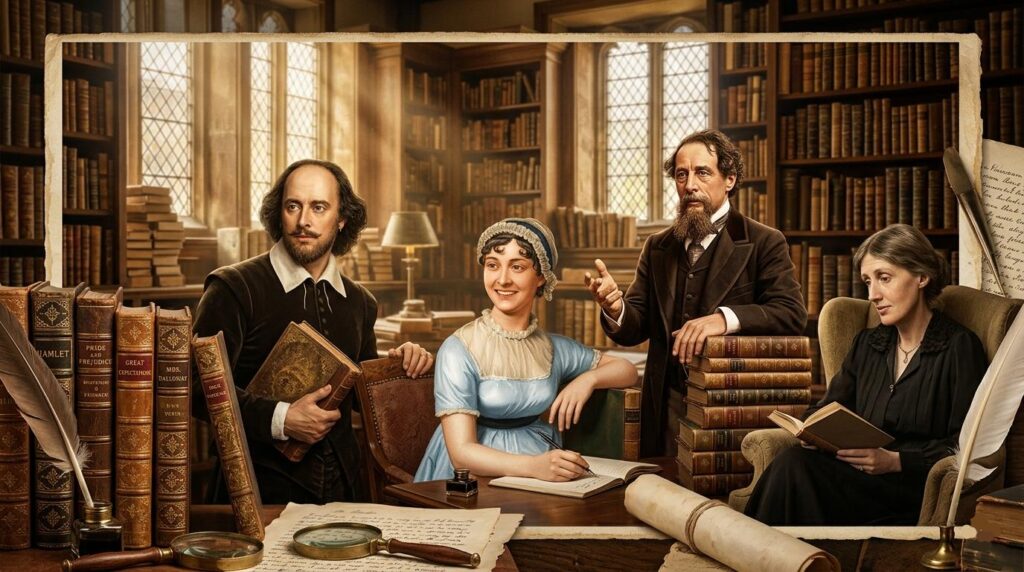
English literature is a vast and ever-evolving field shaped by the contributions of numerous writers across different historical periods. These authors have not only created timeless works but have also influenced language, culture, and thought across generations. While it is impossible to include every significant writer, the following are among the most influential and widely studied authors in English literature, organized by literary period:-
Old English and Middle English writers
The foundations of English literature were laid in the early periods, when oral storytelling gradually gave way to written texts.
- Geoffrey Chaucer, known as the “Father of English Literature,” wrote The Canterbury Tales, which presents a vivid picture of medieval society through engaging storytelling and diverse characters.
- William Langland – Author of Piers Plowman, a deeply symbolic and moralistic poem reflecting religious and social concerns of the time.
These early writers played a crucial role in shaping the English language and literary tradition.
Renaissance writers
The Renaissance period marked a golden age of English literature, characterized by creativity, humanism, and artistic excellence.
- William Shakespeare – The greatest playwright and poet in English literature, known for works like Hamlet, Macbeth, and Romeo and Juliet.
- Christopher Marlowe – A contemporary of Shakespeare, famous for Doctor Faustus, exploring ambition and human desire.
- Ben Jonson – Known for his satirical plays and sharp social commentary.
These writers revolutionized drama and poetry, introducing complex characters and universal themes.
Neoclassical writers
This period emphasized reason, order, and clarity, often reflecting classical ideals.
- John Dryden – A leading figure in literary criticism and poetry.
- Alexander Pope – Known for satirical works like The Rape of the Lock.
- Jonathan Swift – Famous for Gulliver’s Travels, a powerful satire on society and politics.
These authors used literature as a tool to critique society and promote rational thinking.
Romantic writers
The Romantic period celebrated emotion, imagination, and the beauty of nature.
- William Wordsworth – Focused on nature and human emotion in simple yet profound language.
- Samuel Taylor Coleridge – Known for imaginative and supernatural themes.
- Lord Byron – Famous for his passionate and rebellious poetry.
- Percy Bysshe Shelley – A visionary poet advocating freedom and change.
- John Keats – Celebrated for his rich imagery and exploration of beauty.
These poets transformed literature by focusing on individual experience and emotional depth.
Victorian writers
The Victorian era produced some of the most popular and socially conscious literature.
- Charles Dickens – Known for novels addressing social issues and inequality.
- Jane Austen – Famous for her insightful portrayal of society and relationships.
- Thomas Hardy – Explored themes of fate and rural life.
- George Eliot – Known for psychological depth and realism.
- Alfred Lord Tennyson – A leading poet of the era.
These writers highlighted the realities of society and human struggles.
Modern and contemporary writers
Modern literature reflects the complexities of the modern world, experimenting with style and themes.
- George Orwell – Known for political and social commentary.
- Virginia Woolf – A pioneer of modernist writing techniques.
- T.S. Eliot – A major modernist poet.
- James Joyce – Known for innovative narrative styles.
- D.H. Lawrence – Explored human relationships and emotions.
These authors pushed the boundaries of literature and introduced new ways of storytelling.
Contemporary global voices in English Literature
English literature today is global, with writers from different cultures contributing unique perspectives and enriching the literary tradition with diverse themes and experiences.
- Chinua Achebe – Explored African identity, colonialism, and cultural conflict.
- Arundhati Roy – Known for addressing social, political, and human rights issues.
- Chimamanda Ngozi Adichie – Focuses on identity, feminism, and modern African experiences.
- Kazuo Ishiguro – Explores memory, identity, and human emotions with subtle depth.
- Zadie Smith – Writes about multicultural society, race, and modern urban life.
- Margaret Atwood – Known for dystopian fiction and themes of gender and society.
- Jhumpa Lahiri – Explores immigration, identity, and cultural belonging.
- Ngũgĩ wa Thiong’o – Focuses on postcolonial identity, language, and culture.
- V. S. Naipaul – Explores displacement, identity, and postcolonial societies.
- Doris Lessing – Known for psychological insight and social themes.
- J. M. Coetzee – Explores morality, power, and human rights issues.
- Toni Morrison – Focuses on African American identity, history, and culture.
- Alice Walker – Known for themes of race, gender, and social justice.
These writers demonstrate how English literature continues to evolve, representing diverse cultures, voices, and experiences worldwide.
The richness of English literature lies in its diversity. Each author brings a unique voice, style, and perspective, contributing to a vast and dynamic literary tradition. Their works continue to inspire readers, influence writers, and shape the way we understand the world.
How to study English Literature effectively

Studying English literature is not simply about reading texts. It is about engaging with them on a deeper level. It requires curiosity, analysis, and a willingness to explore different perspectives. By adopting the right approach, students can gain a richer understanding of literary works and improve their analytical skills.
Read actively and critically
Active reading is essential for understanding literature. Instead of just following the story, readers should ask questions, analyze characters, and identify themes. Pay attention to the author’s language, tone, and style. Try to understand why certain words or techniques are used and what they contribute to the overall meaning.
Critical reading involves forming your own opinions about the text. It encourages independent thinking and helps you move beyond surface-level understanding.
Understand historical and cultural context
Every piece of literature is influenced by the time and place in which it was written. Understanding the historical and cultural background of a text can provide valuable insights into its themes and characters.
For example, knowing about the social conditions of the Victorian era can help you better understand Charles Dickens’s works. Similarly, understanding the political context of the 20th century can enhance your interpretation of George Orwell’s writings.
Take notes and highlight key ideas
While reading, it is important to note down important points, quotes, and ideas. Highlight passages that stand out or seem significant. This practice helps in remembering key details and makes it easier to revise later.
Writing summaries of chapters or poems in your own words can also improve understanding and retention.
Discuss and share ideas
Literature is open to interpretation, and discussing it with others can provide new perspectives. Engaging in conversations with classmates, teachers, or fellow readers allows you to see the text from different viewpoints.
These discussions not only deepen understanding but also improve communication and analytical skills.
Practice writing and analysis
To truly master literature, it is important to practice writing essays, summaries, and analyses, which help organize thoughts and express ideas clearly. Writing also encourages deeper engagement with the text and strengthens critical thinking.
The role of English Literature in modern life

In today’s fast-paced, technology-driven world, the relevance of English literature remains as strong as ever. While digital media has transformed the way we consume information, literature continues to offer something unique: depth, reflection, and meaningful engagement.
One of the most essential roles of literature in modern life is its ability to enhance communication skills. By reading diverse texts, individuals learn how to express themselves clearly and effectively. This skill is essential in both personal and professional contexts.
Literature also plays a crucial role in developing empathy. In an increasingly interconnected world, understanding different cultures, perspectives, and experiences is more important than ever. Through stories and characters, literature allows readers to step into others’ lives and see the world through their eyes.
Moreover, literature encourages critical thinking in an age where information is abundant but not always reliable. It teaches readers to analyze, question, and interpret information carefully.
In addition, literature serves as a source of inspiration and creativity. Whether it is through storytelling, poetry, or drama, it encourages individuals to think creatively and explore new ideas.
Finally, literature contributes to personal growth. It helps individuals reflect on their own lives, understand their emotions, and find meaning in their experiences. In this way, literature remains a powerful and relevant force in modern society.
Conclusion
English literature is a vast and enriching field that offers deep insight into human life, thought, and emotion. It connects us to the past by preserving history and culture, enhances our present by improving our skills and understanding, and inspires our future by encouraging creativity and critical thinking.
Through the works of great authors, we gain access to a world of ideas and experiences that go beyond our own. Literature teaches us not only how to read and write but also how to think, feel, and interpret the world around us.
In an ever-changing world, the value of English literature remains timeless. It continues to shape minds, inspire hearts, and guide individuals toward a more thoughtful and meaningful life.
By studying literature, we do more than gain knowledge. We develop a deeper understanding of ourselves and the world, making literature not just a subject but a lifelong companion.
Practice MCQs on English Literature – Test your knowledge

Test your understanding of English literature with the following multiple-choice questions based on famous works, authors, and literary concepts.
1. Who wrote Hamlet?
A) Charles Dickens
B) William Shakespeare
C) Jane Austen
D) George Orwell
Answer: B) William Shakespeare
2. Pride and Prejudice is an example of which genre?
A) Drama
B) Poetry
C) Prose (Novel)
D) Tragedy
Answer: C) Prose (Novel)
3. Who is known as the “Father of English Literature”?
A) William Wordsworth
B) Geoffrey Chaucer
C) John Keats
D) T.S. Eliot
Answer: B) Geoffrey Chaucer
4. 1984 by George Orwell is an example of:
A) Historical fiction
B) Romantic poetry
C) Dystopian fiction
D) Comedy
Answer: C) Dystopian fiction
5. Which literary genre is meant to be performed on stage?
A) Poetry
B) Prose
C) Drama
D) Essay
Answer: C) Drama
6. Who wrote The Canterbury Tales?
A) Charles Dickens
B) Geoffrey Chaucer
C) Jane Austen
D) Virginia Woolf
Answer: B) Geoffrey Chaucer
7. Which of the following is a Romantic poet?
A) William Wordsworth
B) George Orwell
C) Charles Dickens
D) Jane Austen
Answer: A) William Wordsworth
8. Macbeth is an example of:
A) Comedy
B) Tragedy
C) Novel
D) Essay
Answer: B) Tragedy
9. Who wrote Pride and Prejudice?
A) Jane Austen
B) Emily Brontë
C) Charles Dickens
D) Virginia Woolf
Answer: A) Jane Austen
10. Which of the following is an example of poetry?
A) Oliver Twist
B) Hamlet
C) Ode to a Nightingale
D) 1984
Answer: C) Ode to a Nightingale
11. Who is famous for writing social novels about Victorian society?
A) Charles Dickens
B) George Orwell
C) T.S. Eliot
D) John Keats
Answer: A) Charles Dickens
12. Which of the following is a non-fiction work?
A) Novel
B) Short Story
C) Biography
D) Drama
Answer: C) Biography
13. Who introduced the stream of consciousness technique?
A) Virginia Woolf
B) Jane Austen
C) Charles Dickens
D) William Shakespeare
Answer: A) Virginia Woolf
14. The Rime of the Ancient Mariner is written by:
A) William Wordsworth
B) Samuel Taylor Coleridge
C) John Keats
D) Lord Byron
Answer: B) Samuel Taylor Coleridge
15. Which genre focuses on imaginary stories?
A) Non-fiction
B) Fiction
C) Essay
D) Biography
Answer: B) Fiction
Frequently Asked Questions
1. What is English literature?
English literature is the study of written works like poems, plays, and novels in the English language.
2. Why is English literature important?
Because it improves language skills, critical thinking, and understanding of human emotions.
3. Who is the father of English literature?
Geoffrey Chaucer is known as the father of English literature.
4. What are the main genres?
Poetry, prose, and drama.
5. How can I improve in literature?
You can improve in literature by reading regularly, analyzing texts, and practicing writing.
6. Who is the most famous writer?
William Shakespeare is widely regarded as the greatest.
7. What is the purpose of literature?
The purpose of literature is to express ideas, emotions, and human experiences.
8. Is literature useful today?
Yes, it develops communication, creativity, and understanding.
9. What is prose?
Prose is a natural form of writing used in novels and stories.
10. What is poetry?
Poetry is a form of writing that uses rhythm and imagery to express emotions.