
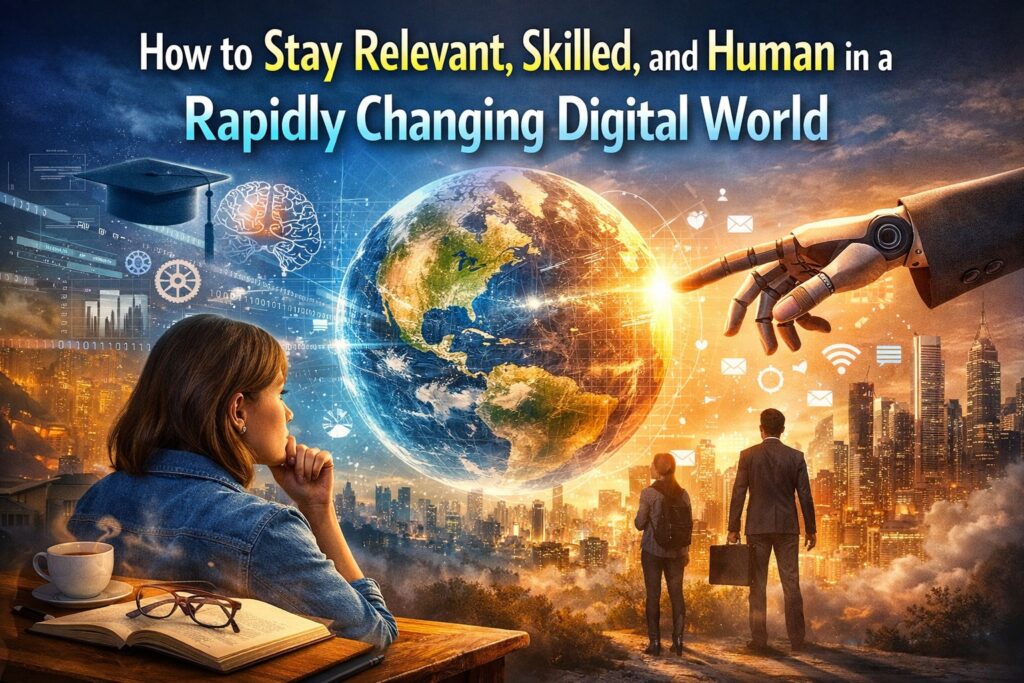
The silent fear we all share
We are living in a digital world where change no longer knocks at the door. It walks straight in and rearranges the furniture. In the digital world, new tools appear overnight, jobs evolve without warning, and skills that once guaranteed stability suddenly feel outdated. Whether you are a student, teacher, writer, professional, or lifelong learner, one question quietly follows you everywhere:
How do I stay relevant in a world that changes so quickly?
This question is not about science and technology alone. It is about confidence, identity, learning, and survival in a digital world where automation and artificial intelligence are becoming part of daily life. Yet, despite all the noise around machines, algorithms, and platforms, one truth remains unchanged:
The future still belongs to humans who can think, learn, adapt, and communicate well.
This article is written to help you understand how to remain skilled, valuable, and human in a rapidly changing digital world, without panic, without hype, and without shortcuts.
1. Technology replacing humans is a myth.
One of the biggest misconceptions today is the idea that technology is replacing humans entirely. In reality, technology replaces tasks, not thinking.
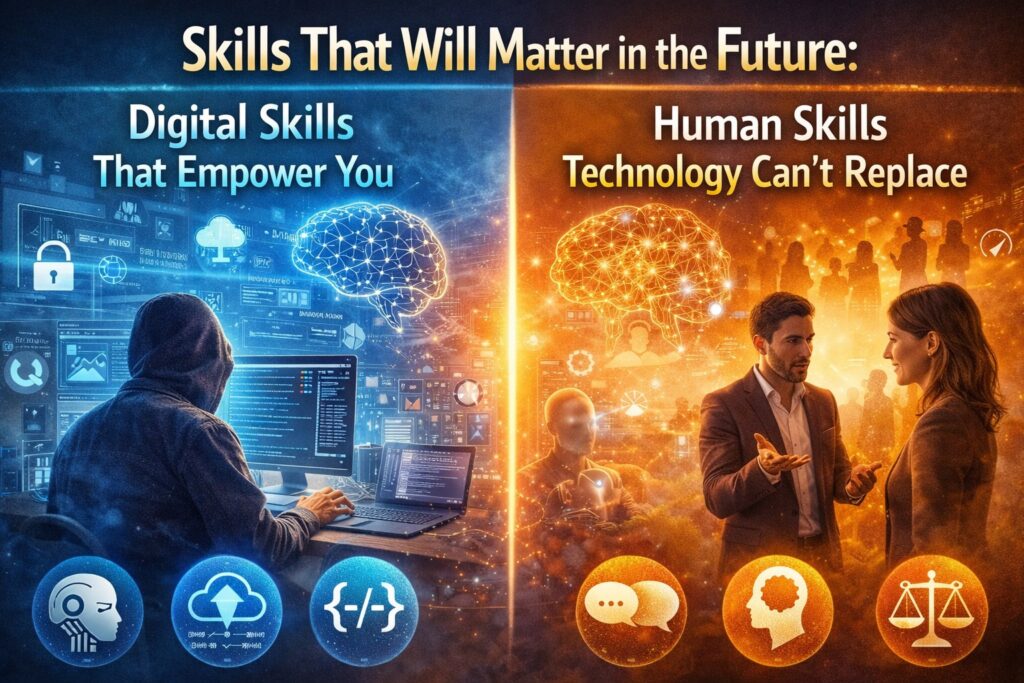
Machines are excellent at:
- Repetition
- Speed
- Data processing
- Pattern recognition
Humans, however, remain superior in:
- Critical thinking
- Creativity
- Judgment
- Emotional understanding
- Ethical decision-making
The people who struggle are not those replaced by machines, but those who refuse to learn how to work alongside change and keep pace with a moving world.
The real danger is not technology.
The real danger is stagnation.
2. Skills that never become obsolete
While tools change rapidly, some skills never lose value. These are the skills that protect you from becoming irrelevant.
a. Clear communication
No matter how advanced technology becomes, humans still need to:
- Explain ideas
- Teach others
- Persuade
- Write
- Speak clearly
People who communicate well always stand out in classrooms, offices, businesses, and online spaces.
b. Critical thinking
Critical thinking means:
- Asking why, not just how
- Evaluating information
- Detecting bias
- Making informed decisions
In a digital world flooded with content, the ability to think clearly is more valuable than ever.
c. Adaptability
Those who survive change are not the strongest, but the most adaptable. Adaptability means:
- Learning new tools
- Updating skills
- Letting go of outdated methods
- Staying curious
3. Why lifelong learning is no longer optional

In the past, education followed a simple model:
Study >> Graduate >> Work >> Retire
That model no longer works in the digital world.
Today, learning is continuous. Skills learned once may become outdated within a few years. This does not mean formal degrees are useless. It means learning cannot stop at graduation.
Lifelong learners:
- Remain employable
- Adjust faster to change
- Feel more confident
- Experience less fear of the future
Learning today does not always require classrooms. Books, online courses, tutorials, and real-world practice are equally powerful.
4. The importance of human judgment in the digital world
Technology can provide information, but it cannot:
- Understand context fully
- Make moral decisions
- Feel responsibility
- Understand consequences emotionally
For example:
- A machine may generate text, but it cannot truly understand human intent
- A system may analyze data, but it cannot feel empathy
Human judgment remains irreplaceable, especially in education, leadership, writing, healthcare, and decision-making roles.
5. Why reading and writing still matter more than ever
Despite videos, podcasts, and short content, reading and writing remain foundational skills.
Reading builds:
- Vocabulary
- Focus
- Deep understanding
- Analytical thinking
Writing develops:
- Clarity of thought
- Logical structure
- Self-expression
- Professional credibility
People who read deeply and write clearly are harder to replace than those who only consume surface-level information.
6. Attention is the most valuable skill nobody talks about
In the digital world, distraction is constant. Notifications, short videos, and endless scrolling slowly reduce our ability to focus.
The ability to concentrate deeply is becoming rare, and therefore valuable.
People who can:
- Focus on one task
- Learn deeply
- Finish what they start
will always outperform those who are constantly distracted.
Protecting your attention is not a luxury. It is a survival skill in this digital world.
7. Building a strong learning habit, not motivation
Many people wait for motivation to learn. Successful learners build habits instead.
Simple habits that work:
- Reading 20 minutes daily
- Writing a short reflection
- Learning one new concept per day
- Practicing consistently, not perfectly
Consistency beats intensity.
8. The role of ethics in a tech-driven world
As technology becomes more powerful, ethical thinking becomes more important in the digital world.
Questions we must ask:
- Should this be done, not just can it be done?
- Who benefits from this change?
- Who might be harmed?
Ethical awareness is a human responsibility, not a technical feature.
9. Why creativity is still a human advantage
Creativity is not limited to art or literature. It includes:
- Problem-solving
- Innovation
- Teaching methods
- New ideas
Creativity thrives on:
- Experience
- Curiosity
- Emotion
- Imagination
These remain deeply human qualities.
10. Finding balance between technology and humanity
Technology should be a tool, not a replacement for human values.
A healthy approach includes:
- Using tools to enhance productivity
- Maintaining human judgment
- Valuing real learning over shortcuts
- Respecting originality
Balance is the key to long-term success.
Conclusion: The future belongs to thoughtful humans
The future is not something to fear. It is something to prepare for.
Those who:
- Keep learning
- Think critically
- Communicate clearly
- Stay adaptable
- Value ethics and creativity
will not only survive change but also shape it.
Technology will continue to evolve, but human instinct, intelligence, responsibility, and curiosity remain irreplaceable.
The goal is not to compete with machines.
The goal is to become the best version of yourself in the digital world.