In this comprehensive guide, we will focus on one of the most fundamental topics in English grammar, the difference between phrases and clauses. By the end of this article, you will not only understand what phrases and clauses are, but also how to use them effectively in your writing.
Phrases and clauses play a fundamental role in English grammar because they act as the building blocks of sentences. They help organize words into meaningful units that convey clear ideas and relationships. A phrase adds detail and enhances a sentence by providing extra information about time, place, manner, or description. However, a clause introduces a complete or partial thought through the presence of a subject and a verb.
Together, they allow writers and speakers to move beyond simple sentences and create more complex, expressive, and precise communication. By combining phrases and clauses effectively, we can expand our ideas, show cause and effect, add conditions, and describe situations in greater depth. This not only improves clarity but also makes writing more engaging and professional. Understanding how phrases and clauses function is therefore essential for mastering sentence structure, avoiding grammatical errors, and developing strong communication skills in both academic and real-life contexts.
Understanding the difference between phrases and clauses is essential for mastering English grammar. Whether you are a student, teacher, or content writer, knowing how phrases and clauses work will improve your writing, speaking, and comprehension skills.
In this detailed guide, we will explore definitions, types, examples, and key differences between phrases and clauses in a simple yet advanced way.
What is a phrase?
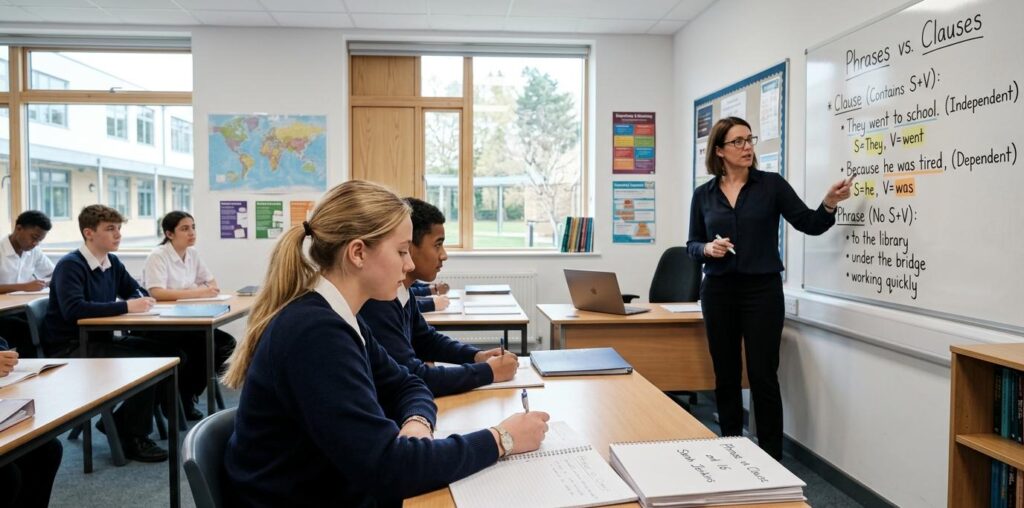
A phrase is a group of words that does not contain both a subject and a verb and does not express a complete thought.
In simple terms, a phrase adds meaning to a sentence but cannot stand alone.
Examples of Phrases
- in the morning
- under the table
- a beautiful flower
- running in the park
Example in a sentence:
She sat under the tree.
Here, under the tree, is a phrase because it does not have a subject + verb combination.
Types of phrases
1. Noun phrase
Acts as a noun.
Example:
The tall boy is my friend.
2. Verb phrase
Contains a main verb and helping verbs.
Example:
She is reading a book.
3. Prepositional phrase
Begins with a preposition.
Example:
The cat is on the roof.
4. Adjective phrase
Describes a noun.
Example:
The boy with curly hair is my brother.
5. Adverb phrase
Modifies a verb.
Example:
She spoke very softly.
What is a clause?
A clause is a group of words that contains a subject and a verb. It may or may not express a complete thought.
Unlike phrases, clauses can sometimes stand alone as sentences.
Types of clauses
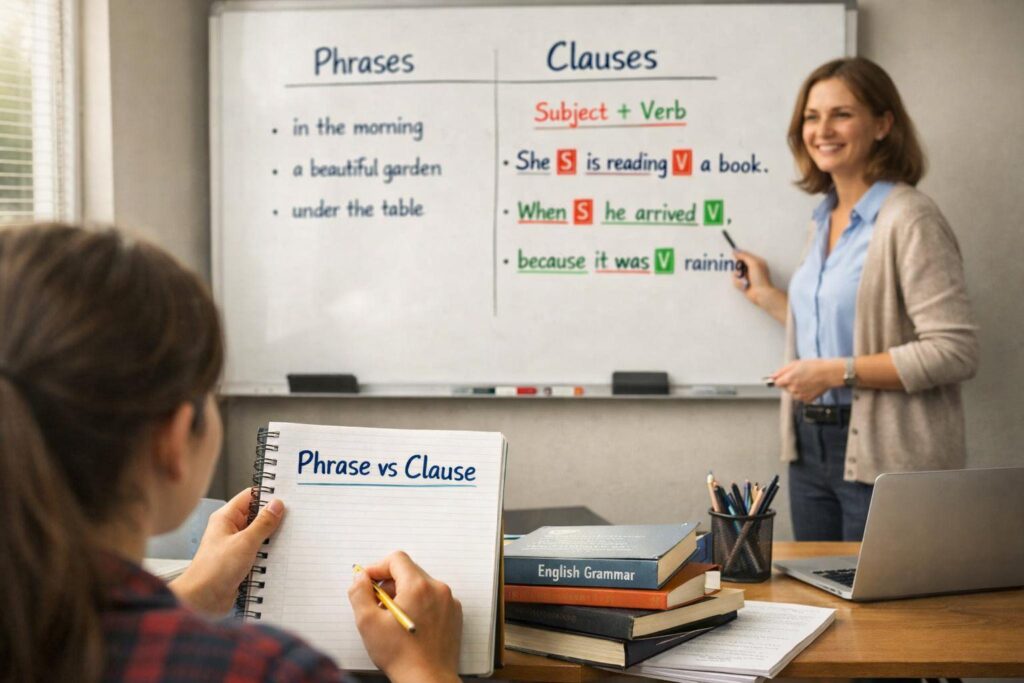
1. Independent clause
An independent clause expresses a complete thought and can stand alone as a sentence.
Example:
She is reading a book.
2. Dependent clause
A dependent clause cannot stand alone and depends on another clause.
Example:
Because she was tired…
Complete sentence:
She went to bed because she was tired.
3. Noun clause
Acts as a noun.
Example:
I know what he did.
4. Adjective clause
Describes a noun.
Example:
The boy who is playing is my brother.
5. Adverb clause
Modifies a verb.
Example:
She left when the bell rang.
Key differences between a phrase and a clause
| Feature | Phrase | Clause |
|---|---|---|
| Subject + Verb | No | Yes |
| Complete Meaning | No | Sometimes |
| Can Stand Alone | No | Sometimes |
| Function | Adds detail | Expresses idea |
Phrase vs clause (simple examples)
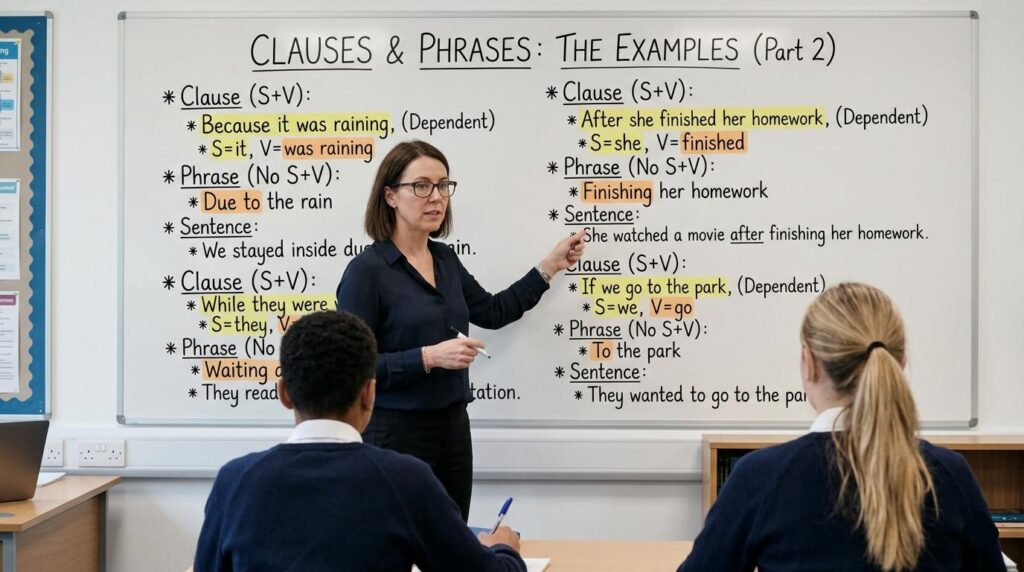
- Phrase: in the room
- Clause: She is in the room
- Phrase: after the rain
- Clause: after the rain stopped
How to identify phrases and clauses
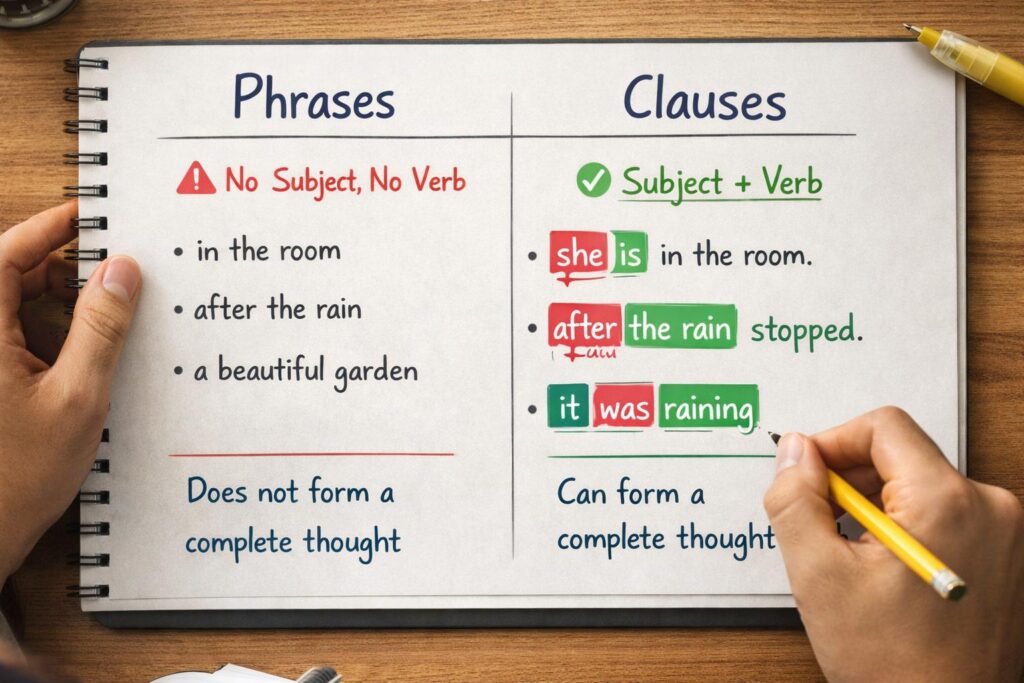
Step 1: Look for subject + verb
If present = Clause
If not = Phrase
Step 2: Check meaning
Complete idea = Clause
Incomplete = Phrase
Common mistakes students make
Mistake 1: Confusing long phrases with clauses
Even long phrases are still phrases if they lack a subject and a verb.
Mistake 2: Ignoring dependent clauses
Dependent clauses have a subject + verb, but are not complete sentences.
Mistake 3: Using fragments in writing
Example:
Because I was late.
Correct:
I missed the bus because I was late.
Importance of learning phrases and clauses
Understanding phrases and clauses helps in:
- Writing grammatically correct sentences
- Improving essay and paragraph writing
- Enhancing communication skills
- Performing well in exams
Advanced usage in writing
Good writers use a mix of phrases and clauses to create complex and engaging sentences.
Example:
Although she was tired, she continued working with great determination.
Here:
- Clause: Although she was tired
- Phrase: with great determination
Conclusion
The difference between phrases and clauses is a fundamental concept in English grammar. A phrase is a group of words without a subject and verb, while a clause includes both and may express a complete thought.
By understanding these concepts, you can improve your writing, avoid common mistakes, and create more effective and meaningful sentences.
Mastering phrases and clauses is an essential step toward becoming a confident and skilled English communicator
Frequently Asked Questions
1. What is the main difference between a phrase and a clause?
A phrase does not contain both a subject and a verb, while a clause contains both and may express a complete idea.
2. Can a clause be a complete sentence?
Yes, an independent clause can function as a complete sentence, but a dependent clause cannot.
3. Is every clause a sentence?
No, only independent clauses can be sentences. Dependent clauses need additional information.
4. Can a phrase become a clause?
Yes, by adding a subject and a verb.
Example:
Phrase: in the garden
Clause: She is in the garden
5. Why is it important to learn phrases and clauses?
It improves grammar, writing clarity, and communication skills.