A few years ago, simply knowing how to use ChatGPT was enough to impress people and was considered one of the AI skills.
Today?
Not so much.
The AI revolution has moved far beyond writing prompts and generating images. Companies are no longer looking for people who can merely use AI tools. They are looking for people who can build, manage, customize, and govern AI systems that solve real-world problems.
At the same time, many AI-related skills that once seemed valuable are rapidly losing relevance. The uncomfortable truth is that some people are preparing for the future of AI. Others are preparing for a version of AI that no longer exists.
If you’re investing your time, energy, and career into artificial intelligence, knowing the difference could save you years of frustration.
Let’s explore the AI skills that are creating real opportunities in 2026 and the ones that are quietly fading away.
Why Most AI Learners are Chasing the Wrong Skills
When a new technology emerges, people often focus on the easiest skills first.
That happened with AI.
Millions of people rushed to learn basic prompting, generate social media posts, create AI art, and automate simple tasks. While those skills were useful for a while, they quickly became accessible to everyone. And when everyone can do something, its value drops.
The skills that pay the most are usually the ones that solve difficult problems, improve business outcomes, and create measurable results.
Those are the skills companies are desperately searching for today.
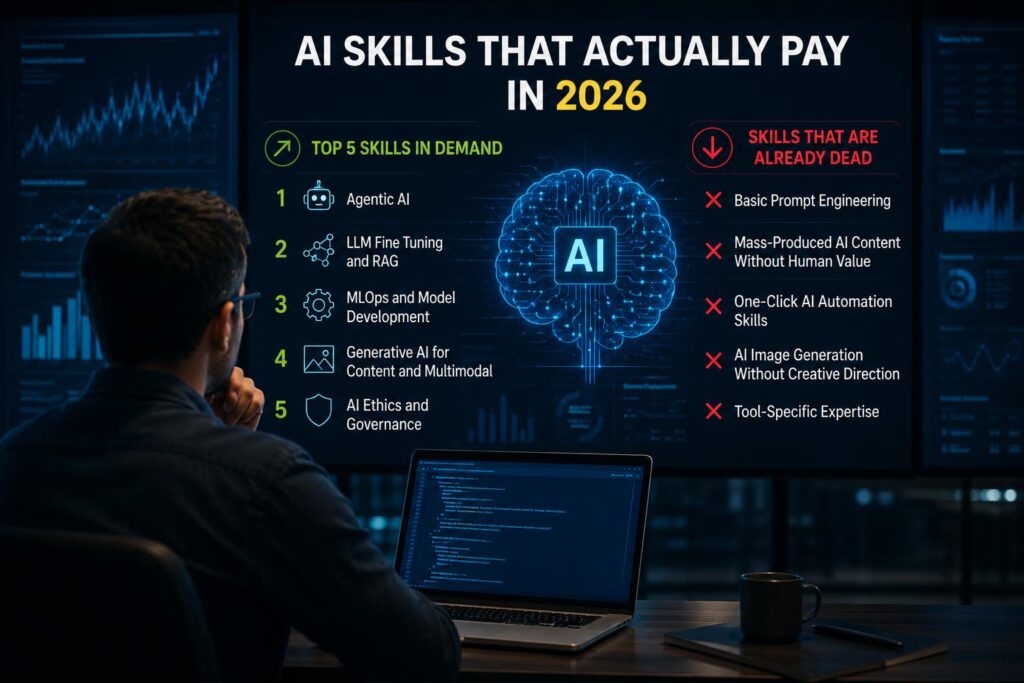
1. Agentic AI – The Future of Autonomous Work
If there’s one AI skill that is attracting massive attention right now, it’s Agentic AI. Unlike traditional AI systems that wait for instructions, AI agents can plan, reason, make decisions, and perform multi-step tasks with minimal human intervention.
Imagine an AI that:
- Conducts research
- Analyzes information
- Creates reports
- Sends emails
- Schedules meetings
- Monitors results
All without constant supervision.
Businesses are increasingly investing in AI agents because they can automate entire workflows rather than individual tasks. Learning how to build, manage, and optimize AI agents may become one of the most valuable technical skills of this decade.
2. LLM Fine-Tuning and RAG
LLMs stand for Large Language Models. ChatGPT, Claude, and Gemini are some of the most powerful examples. But businesses rarely want generic AI. They want AI trained on their own knowledge, products, customers, and internal data. That’s where Fine-Tuning and Retrieval-Augmented Generation (RAG) come in.
These technologies allow organizations to create AI systems that:
- Understand company-specific information
- Answer customer questions accurately
- Access private knowledge bases
- Reduce hallucinations
- Improve reliability
As more organizations adopt custom AI solutions, professionals who understand LLM customization will remain highly valuable.
3. MLOps and Model Development
Building an AI model is only part of the challenge. Keeping it running reliably is where the real work begins. MLOps (Machine Learning Operations) focuses on deploying, monitoring, maintaining, and improving AI systems in production environments. Think of it as the engineering backbone of modern AI.
Companies need professionals who can:
- Deploy models efficiently
- Monitor performance
- Detect failures
- Manage updates
- Scale AI systems securely
As AI becomes integrated into critical business processes, MLOps expertise is becoming indispensable.
4. Generative AI for Content and Multimodal Systems
Many people assume content creation with AI simply means writing blog posts, but the reality is much bigger.
Modern AI systems can work across multiple formats, including:
- Text
- Images
- Audio
- Video
- Documents
- Presentations
This is known as multimodal AI.
Businesses increasingly need professionals who can combine these capabilities to create marketing campaigns, educational content, product demonstrations, customer support systems, and interactive experiences.
The winners will not be those who merely generate content. They will be those who understand how to strategically use AI to communicate, educate, and solve problems.
5. AI Ethics and Governance
As AI becomes more powerful, concerns about privacy, bias, misinformation, security, and accountability continue to grow. Governments, regulators, and organizations around the world are introducing rules for responsible AI use.
This has created a rapidly growing demand for professionals who understand:
- AI compliance
- Risk management
- Ethical frameworks
- Data governance
- Responsible AI deployment
Many experts believe AI governance will become one of the most important career paths in the next decade. Because no matter how advanced AI becomes, organizations will still need humans to ensure it is used responsibly.
AI Skills That Are Already Dying
Now for the uncomfortable part. Some AI skills that once generated excitement are losing value quickly.
1. Basic Prompt Engineering as a Standalone Skill
Prompt engineering is still useful. But being able to write prompts alone is no longer enough.
Modern AI systems are becoming increasingly capable of understanding natural language without requiring complex prompt tricks. Prompting remains important, but it is no longer a complete career path by itself.
2. Mass-Produced AI Content Without Human Value
There was a time when publishing hundreds of AI-generated articles seemed like a shortcut to success. Search engines and readers have become much smarter. Search engines and readers have become much smarter. The future belongs to human-guided AI content, not automated content factories.
3. One-Click AI Automation Skills
Many people built businesses around connecting simple automation tools. Today, platforms increasingly offer these features natively. As AI tools become easier to use, basic automation skills are becoming commoditized.
4. AI Image Generation Without Creative Direction
Generating random images is easy. Creating meaningful visual content that supports business goals is much harder. The value is shifting from tool usage to creative strategy.
5. Tool-Specific Expertise
Many people spend months mastering a single AI tool. Then the market changes. New tools emerge. Features become automated.
The lesson is simple:
Learn concepts, not just tools.
Tools come and go.
Skills endure.
Don’t Build Your Career Around AI Hype
Every technological revolution creates excitement. It also creates distractions. The people who succeed are rarely those chasing every new trend. They are the ones building valuable expertise while everyone else chases shortcuts.
The goal is not to become an AI user. The goal is to become someone who can create value with AI. That difference matters.
Final Thoughts
Artificial intelligence is changing the world faster than most people realize. But not all AI skills are created equal. Some skills are becoming more valuable every day. Others are quietly fading into irrelevance.
If you’re serious about building a future-proof career, focus on:
- Agentic AI
- LLM Fine-Tuning and RAG
- MLOps and Model Development
- Generative and Multimodal AI
- AI Ethics and Governance
Most importantly, remember that technology alone rarely creates success. The real opportunity lies in combining technical knowledge with creativity, critical thinking, communication, and problem-solving. AI may be transforming the future. But the people who thrive will still be those who know how to think, adapt, and create value.