
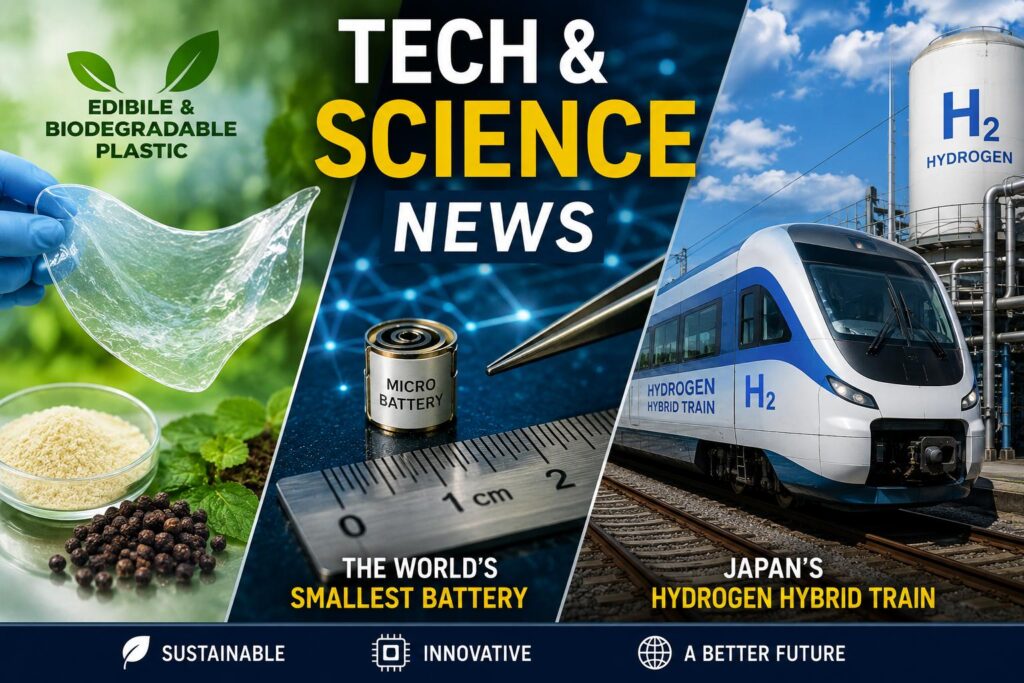
Scientists Develop Edible and Biodegradable Plastic, Tiny Battery, and Hydrogen Hybrid Train
Science and technology are constantly producing fascinating discoveries. Some breakthroughs make headlines when they are first developed, while others continue to evolve through research and testing. Here are three remarkable developments that show how scientists are working toward smarter, smaller, and more sustainable technologies.
Science and technology are constantly changing the way we understand and solve the problems around us. From plastic pollution to microscopic electronics and cleaner transportation, scientists are developing new ideas that could shape the future.
Some of these innovations may sound almost unbelievable. Scientists have developed an edible and biodegradable plastic material, researchers have created an incredibly small rechargeable battery designed for miniature devices, and Japan has been developing a hydrogen-powered hybrid train that combines fuel-cell technology with batteries.
These developments show how science is moving toward smaller, smarter, and more environmentally friendly technologies.
However, these technologies should not be viewed as instant solutions to the world’s problems. Many are still being researched, tested, or developed for specific applications. Their real impact will depend on safety, cost, scalability, and successful commercial use.
Let’s take a closer look at these stunning developments.
Scientists Develop Edible and Biodegradable Plastic
Plastic pollution has become one of the world’s most serious environmental challenges. Conventional plastics are extremely durable and can remain in the environment for very long periods. When plastic waste is poorly managed, it can accumulate on land and enter rivers, oceans, and other ecosystems.
Scientists have therefore been searching for alternatives that can perform some of the functions of conventional plastic while reducing its environmental impact.
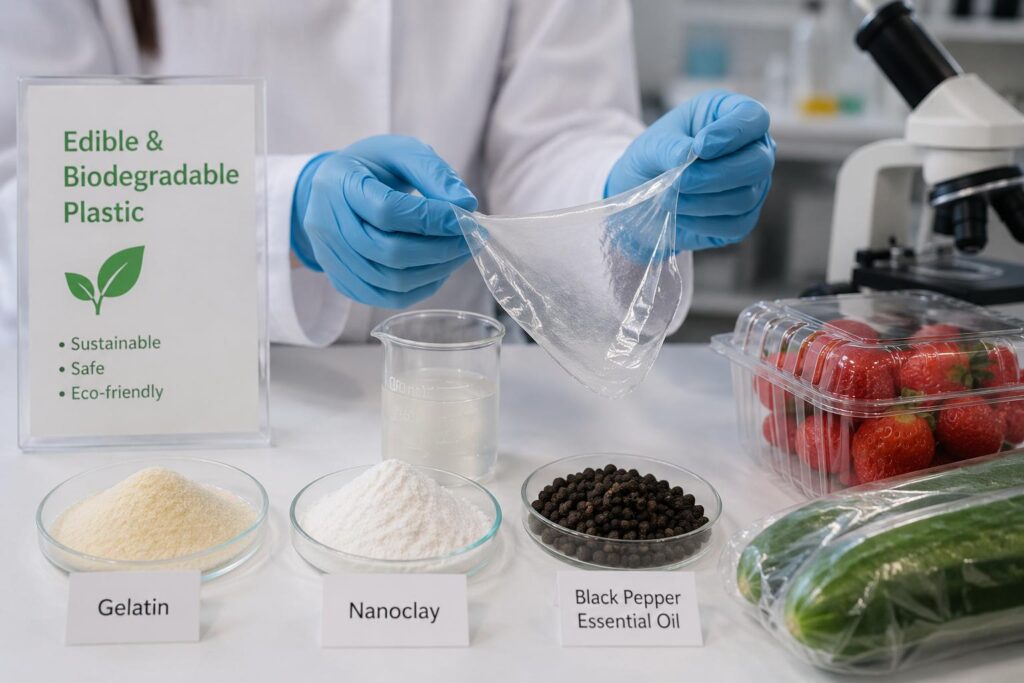
One interesting development came from researchers associated with São Paulo State University (UNESP) in Brazil, who developed a biodegradable plastic film made from biological materials.
The material was based on Type B bovine gelatin, a biodegradable protein material. Researchers combined the gelatin with nanoclay and a nanoemulsion containing black pepper essential oil to improve the material’s properties.
The result was a flexible bioplastic film with interesting mechanical, antioxidant, and antimicrobial characteristics.
What Makes This Plastic Different?
Traditional petroleum-based plastic is valued because it is strong, lightweight, flexible, and relatively inexpensive. Replacing it is therefore not as simple as finding a material that is merely biodegradable.
The researchers wanted to improve the strength and useful properties of the gelatin-based material.
Nanoclay helped improve the mechanical performance of the film, while the black-pepper essential-oil nanoemulsion contributed antimicrobial and antioxidant properties.
The researchers reported a tensile strength of around 70 megapascals, demonstrating that the material could achieve impressive mechanical performance for a biodegradable film.
This does not mean that the material can immediately replace every type of conventional plastic. Instead, it demonstrates the potential of combining biological materials with nanotechnology to create new forms of packaging.
Could This Bioplastic Really Be Eaten?
The word “edible” makes this discovery particularly interesting.
Because the material is made from food-related biological components such as gelatin and contains food-associated ingredients, researchers explored its potential for edible packaging.
However, edible does not mean that people should simply eat the material as a food product.
The research is more accurately understood as an exploration of edible and biodegradable packaging materials that could potentially be used in certain food applications.
Such materials would still need to meet appropriate safety, regulatory, manufacturing, and consumer requirements before widespread commercial use.
How Could Biodegradable Plastic Help?
If materials like this can eventually be produced economically and at large scale, they could have applications in areas such as:
- Food packaging
- Single-use packaging
- Protective food films
- Specialty packaging
- Environmentally conscious packaging applications
One potential advantage is that biodegradable materials can be designed to break down more readily than conventional petroleum-based plastics under appropriate environmental conditions.
However, biodegradability depends on the material and the conditions in which it is discarded. A biodegradable material should not automatically be assumed to disappear quickly in every environment.
This is an important distinction when discussing alternatives to conventional plastic.
The World’s Smallest Battery Could Power Tiny Devices
The second scientific development takes us from environmental science to an entirely different area: microscopic energy storage.
Scientists have developed extremely small batteries to address one of the biggest challenges facing miniature electronics.
Modern technology continues to become smaller. Researchers are developing tiny sensors, medical devices, microrobots, and other miniature electronic systems.
But there is a fundamental problem:
How can electricity be provided to something that is almost microscopic?
A conventional battery can be far too large for such devices.
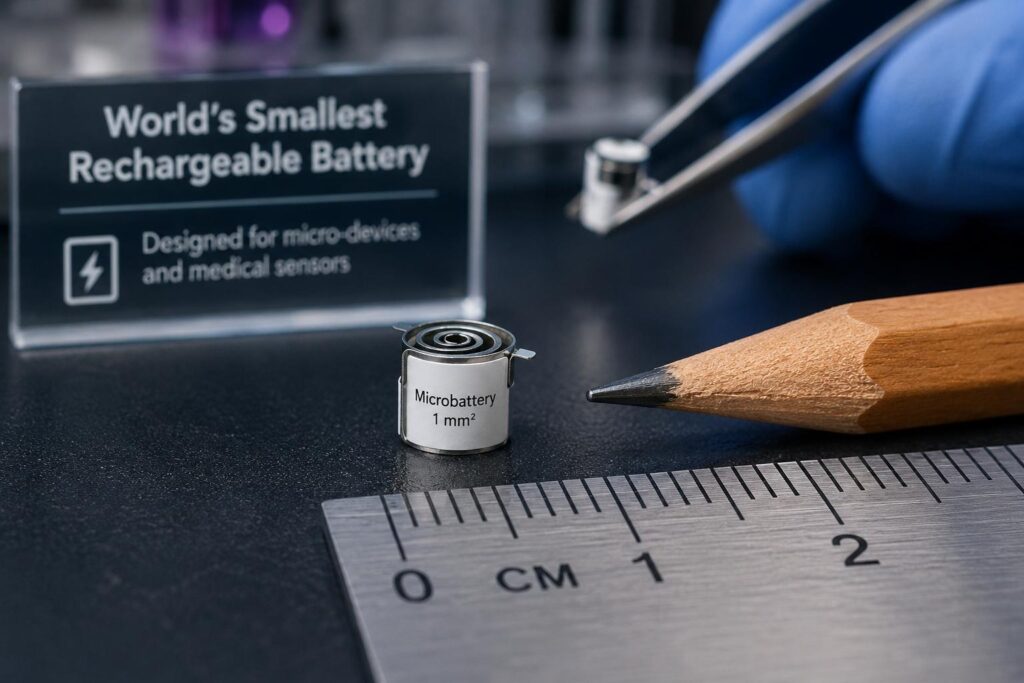
Researchers at Chemnitz University of Technology in Germany, working with partners including Leibniz IFW Dresden, developed a remarkably small rechargeable battery designed for miniature electronic systems.
The device is less than one square millimeter in size and uses a special structure inspired by the way a Swiss roll is formed.
How Does the Tiny Battery Work?
The battery uses extremely thin layers of different materials that are arranged into a compact structure.
The researchers used a technique based on self-assembly and microfabrication to create the miniature energy-storage system.
Instead of simply making a conventional battery smaller, the scientists developed a structure specifically suited to extremely small electronic devices.
This approach allows several functional layers to be packed into a very small space.
The researchers reported an energy density of approximately 100 microwatt-hours per square centimeter, demonstrating the potential of the technology for miniature electronic systems.
Where Could Such a Tiny Battery Be Used?
A battery this small may sound like a curiosity, but miniature energy storage could have important applications.
Potential areas include:
Medical Devices
Tiny sensors placed inside or on the human body could monitor information such as physiological conditions.
Future miniature medical devices may require their own small energy sources to operate without relying on large external batteries.
Microrobots
Scientists are exploring extremely small robots that could potentially perform specialized tasks.
Providing energy to such machines is one of the major engineering challenges.
Miniature Sensors
Small sensors could be used in medical, environmental, industrial, or scientific applications.
A compact battery could make it easier to develop autonomous sensor systems.
Internet of Things
The Internet of Things depends on large numbers of connected devices and sensors.
Some of these devices need extremely small power sources, particularly when size is a major limitation.
Why Is a Tiny Battery Important?
Making a battery smaller is not simply a matter of reducing its dimensions.
As electronic devices become smaller, the energy source must also become smaller without losing too much performance.
Researchers therefore have to balance:
Size + Energy Density + Power + Safety + Rechargeability
This is why miniature battery research is so important.
A successful microbattery could help researchers build electronic devices that are smaller, more flexible, and capable of operating in places where conventional batteries cannot be used.
At the same time, these technologies are still developing, and practical applications depend on further research, manufacturing improvements, reliability, and cost.
Japan Develops a Hydrogen Hybrid Train for Cleaner Rail Travel
The third development comes from the world of transportation.
Railways are already among the more efficient forms of mass transportation, but railway operators are still looking for ways to reduce carbon emissions.
Electrification is one important solution, but installing traditional overhead electrical infrastructure can be difficult or expensive on some railway routes.
Japan has therefore been exploring another possibility:
Hydrogen-powered trains.
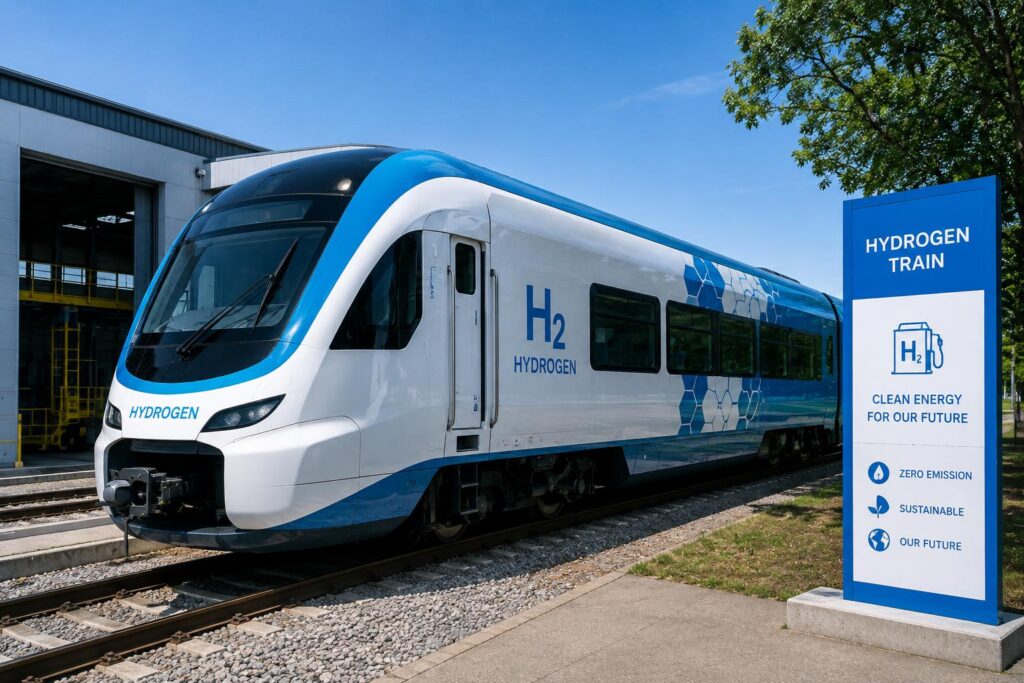
Japan’s railway company JR East has been developing a hydrogen hybrid train system known as HYBARI.
The system combines a hydrogen fuel cell with a rechargeable battery.
How Does a Hydrogen Hybrid Train Work?
A hydrogen fuel-cell train works differently from a conventional diesel train.
Hydrogen is stored onboard the train and supplied to a fuel cell.
The fuel cell generates electricity, which can then be used to power the train’s electric motors.
A battery is also incorporated into the system.
The battery can store electrical energy, including energy recovered through regenerative braking.
In simple terms, the system combines:
Hydrogen Fuel Cell + Battery + Electric Motors
This allows the train to use hydrogen as an energy source while taking advantage of battery technology.
Why Is Hydrogen Interesting for Trains?
Hydrogen could become useful for railway routes where conventional electrification is difficult.
Installing overhead electrical lines requires significant infrastructure. Some routes may not carry enough traffic to justify the cost of complete electrification.
Hydrogen trains could provide another option.
The concept is particularly interesting because the fuel cell itself does not produce carbon dioxide during its electricity-generating process. Its main direct by-product is water.
However, the overall environmental benefit depends partly on how the hydrogen is produced.
If hydrogen is produced using low-carbon energy, its potential environmental advantages can be greater. If it is produced using carbon-intensive methods, the overall emissions can be considerably higher.
Therefore, hydrogen should not automatically be described as completely “green.”
Japan’s Hydrogen Train Development
JR East has been testing hydrogen hybrid train technology as part of its efforts to reduce carbon emissions.
The HYBARI development combines hydrogen fuel-cell technology with battery storage and regenerative braking.
The company has stated plans to move toward the operation of hydrogen hybrid trains as part of its longer-term efforts to reduce emissions from railway transportation.
This is an example of how transportation technology is moving beyond the traditional choice between diesel and conventional electric rail.
Three Different Technologies, One Common Goal
At first glance, these three discoveries appear unrelated.
One involves plastic.
Another involves a microscopic battery.
The third involves trains.
But they share an important idea:
Scientists are searching for better ways to use resources while reducing environmental and technological limitations.
The biodegradable plastic research focuses on creating alternative materials.
The microbattery research focuses on supplying energy to devices that are too small for conventional batteries.
The hydrogen train focuses on developing cleaner alternatives for transportation.
Together, they demonstrate how innovation can occur at completely different scales, from microscopic electronic components to full-sized trains.
The Challenges Behind These Innovations
It is easy to become excited when reading about new scientific discoveries. However, a laboratory breakthrough is not automatically a finished commercial product.
Scientists and engineers must answer many questions before a technology can be used widely.
Cost
Can it be produced cheaply enough to compete with existing technologies?
Large-Scale Manufacturing
Can laboratory production be expanded to factories without losing quality?
Safety
Is the material or technology safe for people and the environment?
Reliability
Can it continue working effectively over months or years?
Environmental Impact
Does the technology actually reduce environmental damage when its complete life cycle is considered?
Infrastructure
Can existing systems support the new technology?
These questions can take years to answer.
That is why scientific progress should be viewed as a journey rather than a single discovery.
The Future of Sustainable Technology
The world faces several major challenges at the same time.
Plastic pollution continues to create environmental problems. Digital devices are becoming smaller and more powerful. Transportation systems need to reduce their dependence on carbon-intensive energy.
There is no single invention that can solve all these problems.
Instead, progress is likely to come from thousands of innovations working together.
Biodegradable materials could reduce dependence on certain conventional plastics.
Advanced microbatteries could help power the next generation of miniature sensors and medical technologies.
Hydrogen and battery technologies could provide additional options for cleaner transportation.
The most exciting part is that these technologies are still developing.
What seems experimental today could become a practical part of everyday life tomorrow, but only if scientists can overcome the technical, economic, environmental, and safety challenges involved.
What Can We Learn From These Scientific Developments?
These discoveries offer an important lesson.
Science does not always produce immediate solutions. Sometimes researchers spend years improving a material, testing a battery design, or developing a transportation system before it becomes commercially useful.
The important thing is the process of experimentation.
A material that once seemed too weak may become stronger through nanotechnology.
A battery that was once too large may eventually become smaller than a grain of salt.
A train that traditionally depended on diesel may eventually use hydrogen and battery technology.
This is how technological progress happens-one experiment, one improvement, and one discovery at a time.
Final Thoughts
From edible and biodegradable packaging to microscopic batteries and hydrogen-powered trains, modern science is exploring solutions to some of the world’s most difficult challenges.
These innovations remind us that the future of technology is not limited to faster computers or more powerful smartphones.
It also includes smarter materials, smaller machines, cleaner energy, and more sustainable ways of living.
Some of today’s experimental technologies may become tomorrow’s everyday solutions.
The journey from a laboratory experiment to a technology used by millions can be long, but every successful experiment brings us one step closer to a more innovative and sustainable future.
Science continues to show us that even the smallest invention can have a very big impact.
Frequently Asked Questions
1. What is the edible plastic developed by scientists?
Researchers associated with São Paulo State University developed a biodegradable film based on Type B bovine gelatin, nanoclay, and a nanoemulsion containing black pepper essential oil. The material showed interesting mechanical, antioxidant, and antimicrobial properties.
2. Is the edible plastic meant to replace all conventional plastic?
No. The research demonstrates potential for specific applications, particularly food packaging. It does not mean that the material can immediately replace every type of conventional plastic.
3. Is biodegradable plastic the same as ordinary plastic?
No. Biodegradable plastics are designed to break down under appropriate conditions, while many conventional petroleum-based plastics can persist for very long periods. However, biodegradability varies between materials and environmental conditions.
4. How small is the microbattery?
Researchers at Chemnitz University of Technology developed a rechargeable microbattery that is less than one square millimeter in size, making it suitable for research into extremely small electronic devices.
5. What could tiny batteries be used for?
Potential applications include miniature sensors, medical devices, microrobots, Internet of Things devices, and other very small electronic systems.
6. How does a hydrogen train work?
A hydrogen fuel-cell train uses hydrogen to generate electricity through a fuel cell. The electricity powers electric motors, while a battery can store energy and support the system, including energy recovered during braking.
7. Is hydrogen completely environmentally friendly?
Not necessarily. The environmental impact of hydrogen depends heavily on how it is produced. Hydrogen produced using low-carbon energy can have a much lower carbon footprint than hydrogen produced using carbon-intensive methods.
8. Are these technologies already widely available?
Not necessarily. Some of these developments are research or demonstration technologies. Moving from laboratory research to widespread commercial use requires further testing, manufacturing development, investment, and regulatory approval where applicable.