

Why motivation without self-discipline is never enough
Almost everyone has experienced it. One day, you feel inspired, energetic, and ready to change your life. You make plans, write goals, and promise yourself that this time will be different. Then, a few days later, the motivation fades. The excitement disappears, and slowly, old habits return.
This cycle is so common that many people begin to believe they are “not motivated enough.” But the truth is far more important, and far more hopeful.
Motivation is unreliable. Discipline is not.
The first and best victory is to conquer self.
PLATO
This article is not about quick inspiration or temporary excitement. It is about understanding why motivation fails, how self-discipline works, and how ordinary people achieve extraordinary results by relying on systems, habits, and inner commitment rather than feelings.
If you have ever struggled to stay consistent, this article is for you.
1. Understanding what motivation really is
Motivation is an emotional state. It is influenced by:
- Mood
- Environment
- Sleep
- Stress
- External events
Because emotions change, motivation changes too. This is not a weakness. It is human nature.
Motivation works well for:
- Starting something new
- Creating excitement
- Setting direction
But motivation is not designed for consistency. It fades and changes with the modes and environment.
That is why people feel motivated to:
- Start a workout plan
- Begin a new study routine
- Learn a new skill
Yet struggle to continue after the initial excitement fades.
2. Why relying on motivation often leads to failure
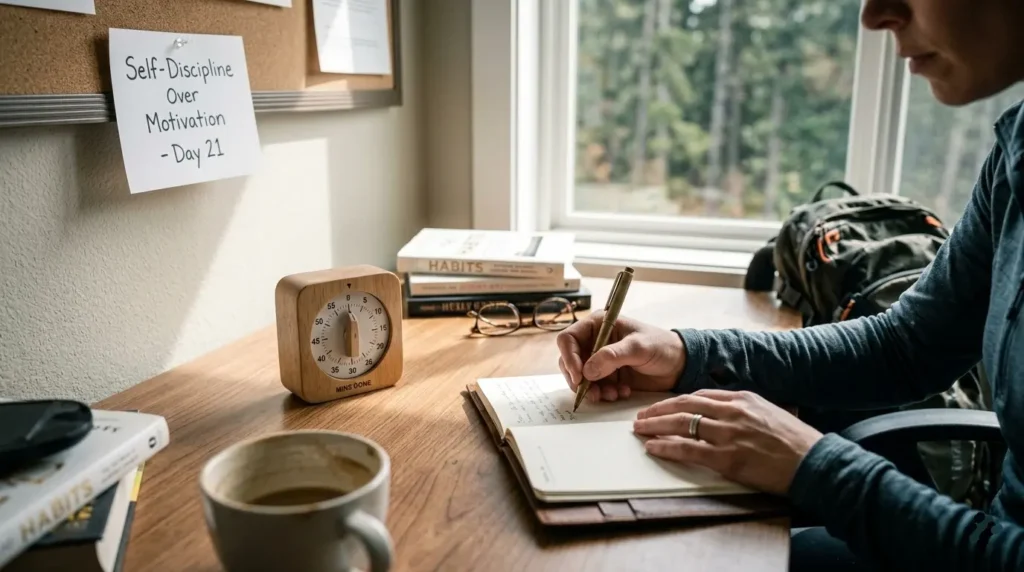
When people depend only on motivation, they unknowingly set themselves up for disappointment.
Here is what usually happens:
- Motivation rises
- Action begins
- Motivation drops
- Action stops
This creates guilt, frustration, and self-doubt.
Over time, people start saying:
- “I lack discipline.”
- “I’m not consistent.”
- “Others are stronger than I am.”
In reality, successful people feel the same lack of motivation. They just don’t let it decide their actions.
3. What self-discipline actually means
Self-discipline is not about being harsh or strict with yourself. It is about acting according to values, not emotions.
Self-discipline means:
- Doing what needs to be done even when you don’t feel like it
- Choosing long-term benefit over short-term comfort
- Following a plan despite emotional resistance
Self-discipline is not a talent.
Self-discipline is a skill, and skills can be learned.
4. The quiet power of consistency
Success rarely comes from dramatic effort. It comes from small actions repeated consistently.
Consider these examples:
- Reading 10 pages a day
- Writing 300 words daily
- Walking 20 minutes regularly
- Studying one topic deeply
These actions seem insignificant on a single day. But over months and years, they compound into powerful results.
Consistency transforms ordinary effort into extraordinary outcomes.
5. Why self-discipline creates freedom, not restriction

Many people think discipline limits freedom. In reality, the opposite is true.
Lack of self-discipline creates:
- Stress
- Missed opportunities
- Regret
- Dependence on circumstances
Self-discipline creates:
- Confidence
- Control
- Progress
- Inner stability
When you control your actions, you control your direction.
6. Building self-discipline without burning out
Self-discipline does not mean forcing yourself endlessly. Sustainable discipline is built on realistic systems, not punishment.
a) Start smaller than you think necessary
The biggest mistake people make is starting too big.
Instead of:
- Studying 3 hours, start with 20 minutes at the beginning
- Exercising daily, start with 3 days a week initially
Small wins build trust in yourself.
b) Remove friction, not willpower
Self-discipline becomes easier when resistance is reduced.
Examples:
- Prepare study materials in advance
- Keep distractions out of reach
- Schedule tasks at fixed times
Good systems reduce the need for constant self-control.
c) Focus on identity, not outcomes
Instead of saying:
- I want to succeed.
Say:
- I am someone who shows up daily.
Identity-based self-discipline lasts longer than goal-based motivation.
7. The role of failure in self-discipline
Failure is not a sign of weakness. It is a sign of effort.
Self-disciplined people do not avoid failure. They recover from it more quickly.
Key mindset:
- Missing one day is normal
- Quitting entirely is optional
The ability to return after failure is a form of self-discipline.
8. Mental strength is built, not born
Mental strength is often misunderstood. It does not mean:
- Never feeling tired
- Never doubting
- Never feeling emotional
Mental strength means:
- Continuing despite doubt
- Acting despite fear
- Showing up despite discomfort
Strength grows through repeated exposure to challenge, not comfort.
9. Motivation still has a role when used correctly

Motivation is not useless. It just has a different role.
Use motivation to:
- Define goals
- Visualize outcomes
- Remind yourself why you started
But rely on discipline to:
- Maintain effort
- Build habits
- Achieve results
Motivation lights the fire. Self-discipline keeps it burning.
10. Daily practices that strengthen discipline
You do not become disciplined overnight. You become disciplined through daily choices.
Simple practices:
- Fixed sleep routine
- Daily reading
- Journaling progress
- Limiting digital distractions
- Reflecting weekly
Discipline is trained, just like a muscle is trained and built in the gym.
11. The long-term view: Playing the infinite game
Many people quit because they expect quick results. Real growth takes time and effort in the form of self-discipline.
Those who succeed understand:
- Progress is slow
- Results are delayed
- Effort compounds
They stop asking:
Is this working today?
And start asking:
Will this matter in one year?
12. Motivation for students, creators, and learners
If you are:
- A student struggling with consistency
- A writer or content creator
- A lifelong learner
Then discipline is your greatest ally that will lead you through all ups and downs.
Talent opens doors.
Discipline keeps them open.
Conclusion: Choose discipline, and motivation will follow
Motivation comes and goes. Discipline stays. One motivation comes from discipline when success is achieved, which is the real motivation that makes discipline easy to follow.
When you act consistently:
- Confidence grows
- Identity strengthens
- Motivation returns naturally
The real secret to success is not feeling inspired every day.
It is showing up even on uninspired days.
Choose discipline first.
Motivation will catch up.
If you enjoyed this article, explore more insights on learning, discipline, and personal growth in the Motivation section of Study2Inspire.
FAQs
Is motivation useless without discipline?
Motivation helps start action, but discipline is required to maintain consistency and achieve lasting results.
Can self-discipline be learned?
Yes. Self-discipline is a skill developed through habits, systems, and repeated practice.
Why do successful people rely on discipline?
Because discipline allows progress even when emotions and motivation fluctuate.