Why advanced English Grammar still matters in the wondrous AI Era
English fluency is no longer rare. Millions of people speak English confidently and fluently, write daily emails, publish blog posts, and even create AI-assisted content. Yet, advanced English Grammar mistakes remain one of the biggest reasons why writing still sounds slightly off, less authoritative, or non-native.
Ironically, these errors are not basic English Grammar mistakes like subject-verb agreement or article misuse. They are subtle, high-level issues that even fluent speakers, teachers, professionals, and content creators make, often without realizing it.
This guide focuses on advanced English grammar problems that:
- reduce credibility in academic and professional writing
- affect SEO, readability, and clarity
- are frequently missed by grammar tools and AI checkers
If you already speak English well but want your writing to sound polished, precise, and native-level, this article is for you.
1. Misusing advanced verb tenses in complex contexts
Fluent speakers often know all the tenses, but misuse them when sentences become long or abstract.
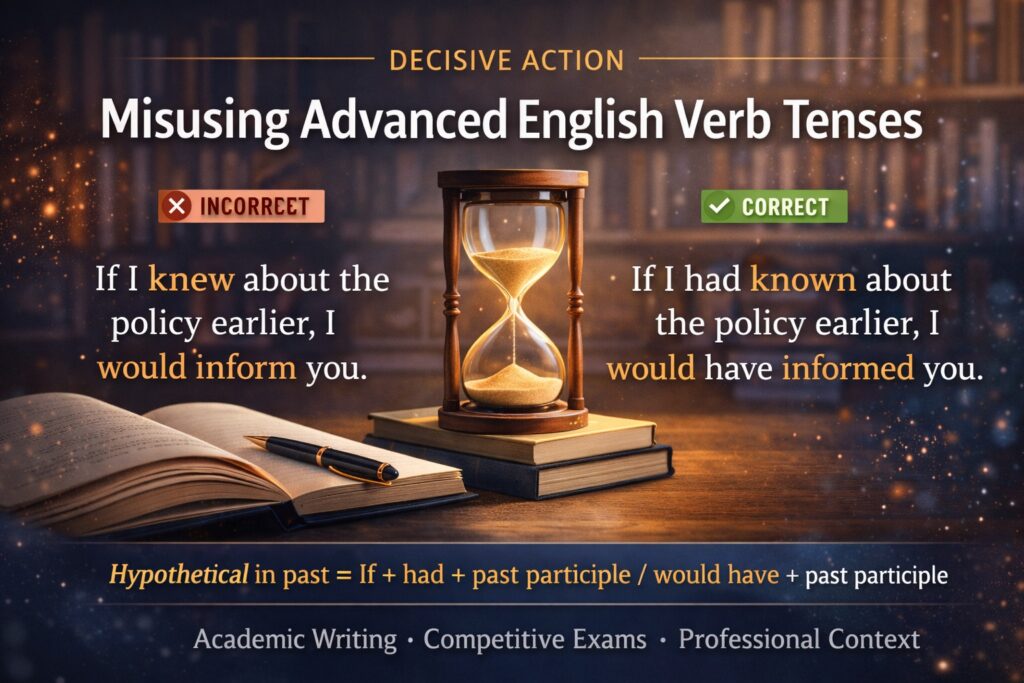
Common mistake
If I knew about the policy earlier, I would inform you.
Correct
If I had known about the policy earlier, I would have informed you.
Why this happens
In conditional sentences involving past hypotheticals, the correct structure is:
- If + past perfect
- would have + past participle
Many fluent users unintentionally downgrade the tense because spoken English often simplifies grammar.
Where this matters most
- Academic writing
- Formal emails
- IELTS / CSS / UPSC essays
- Professional reports
2. Incorrect use of nominalisation (over-abstract writing)
Nominalisation means turning verbs into nouns, a hallmark of advanced writing. But overuse makes writing heavy and unclear.
Weak
The implementation of the regulation resulted in the improvement of efficiency.
Strong
Implementing the regulation improved efficiency.
Advanced insight
Nominalisation is useful in legal and academic writing, but excessive use:
- reduces readability
- lowers engagement
- harms SEO (longer sentences, lower clarity)
Power writing balances abstraction with action.
3. Confusing near-synonyms with different grammatical behaviour

Advanced learners know many synonyms, but grammar changes with meaning.
Example: Suggest vs Recommend
Wrong
She suggested me to apply.
Correct
She suggested that I apply.
She recommended me for the position.
Key rule
Some verbs:
- do not take direct objects
- require clauses instead
This is a very common non-native marker in fluent writing.
4. Overusing passive voice where precision is required
Passive voice is not wrong, but misuse weakens advanced writing.
Vague
Mistakes were made during the process.
Precise
The research team made errors during data analysis.
Advanced tip
Use passive voice only when
- the action matters more than the actor
- the actor is unknown or irrelevant
In analytical writing, clarity beats formality.
5. Misplaced modifiers in long sentences
The longer the sentence, the higher the risk as the structure of the sentence becomes more complex.
Incorrect
While reviewing the article, several grammar issues were identified.
Correct
While reviewing the article, I identified several grammar issues.
Why is this advanced
Because the sentence sounds correct, but fails logically. These errors
- confuse readers
- reduce trust
- are often missed by AI tools
6. Incorrect register mixing (formal + informal collision)
Fluent speakers often mix registers unconsciously.
Mixed
The results were significant, and the experiment kind of failed later.
Consistent
The results were significant; however, the experiment later failed.
Why it matters
Register inconsistency
- weakens academic tone
- affects professional perception
- hurts publication-quality writing
7. Advanced preposition errors that change meaning
Prepositions are meaning-sensitive, not just grammatical.
Wrong
She is married with a doctor.
Correct
She is married to a doctor.
Another Example:
- Interested in (not interested on)
- Responsible for (not responsible of)
These mistakes persist even at high fluency levels.
8. Faulty parallelism in complex lists
Parallel structure is a hallmark of elegant English.
Incorrect
The job requires managing teams, coordination of projects, and to communicate clearly.
Correct
The job requires managing teams, coordinating projects, and communicating clearly.
Parallelism failures often appear in
- resumes
- SOPs
- academic introductions
9. Over-reliance on AI grammar tools
AI tools correct surface errors, not deep grammar logic.
What AI often misses
- tense consistency across paragraphs
- subtle conditional errors
- register mismatches
- logical sentence relationships
Human grammar awareness still matters.
10. Incorrect use of “which” vs “that” in defining clauses
Incorrect
The book which explains quantum theory is complex.
Better
The book that explains quantum theory is complex.
Rule (Advanced)
- That – defining clause
- Which – non-defining clause
This distinction improves clarity and academic precision.
11. Ambiguous pronoun references in long paragraphs
Confusing
When John discussed the report with Mark, he was concerned.
Who was concerned?
Clear
When John discussed the report with Mark, John expressed concern.
Clarity beats elegance.
12. Overusing “very”, “really”, and weak intensifiers
Advanced English avoids emotional padding.
Weak
The theory is very important.
Strong
The theory is fundamental.
Strong vocabulary replaces intensifiers.
13. Incorrect article usage with abstract nouns
Wrong
The knowledge is power.
Correct
Knowledge is power.
Articles with abstract nouns are context-dependent, not rule-based, a major challenge even for fluent speakers.
14. Time reference confusion in academic writing
Inconsistent
The study explains the phenomenon and showed significant results.
Consistent
The study explains the phenomenon and shows significant results.
Choose one time frame unless there’s a reason to shift.
15. Sentence rhythm and information flow problems
Advanced writing is not just grammar. It’s flow.
Poor flow
The study was conducted in 2024. It focused on education. The results were surprising.
Improved
The 2024 study on education produced surprising results.
Why these mistakes matter more than ever
Because in this fast digital world
- Content is everywhere
- AI writes basic English effortlessly
- Advanced grammar signals human expertise
Grammar is no longer about correctness. It’s about authority.
How to reach native-level precision
To truly master advanced English grammar
- Focus on logic, clarity, and tone
- Read high-quality academic and editorial writing
- Edit consciously, not mechanically
- Treat grammar as a thinking skill, not a rulebook
Fluency is common. Precision is rare.
And precision is what sets expert writers apart.